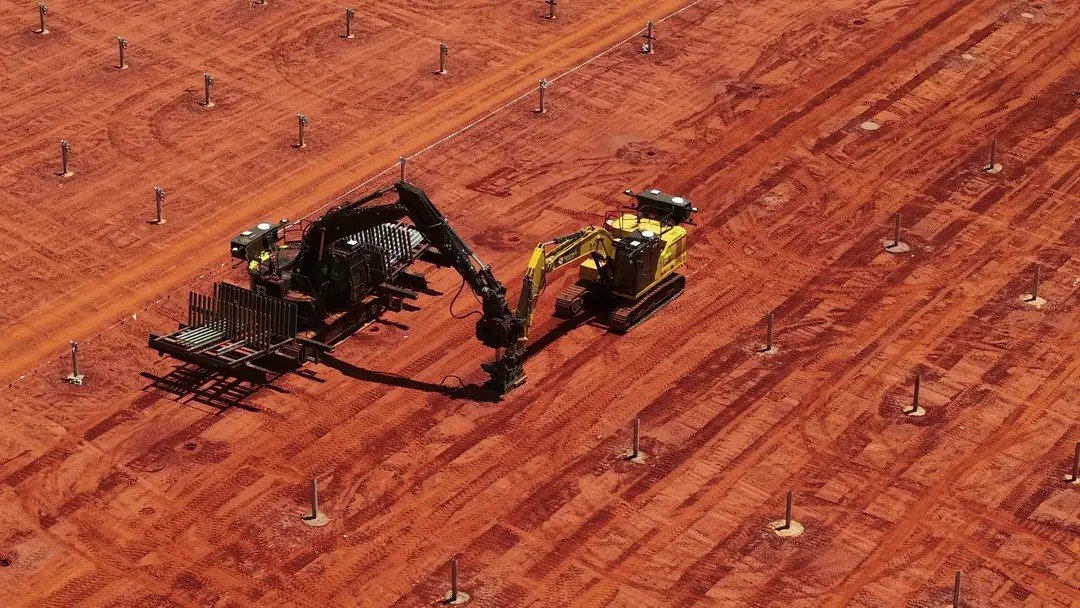





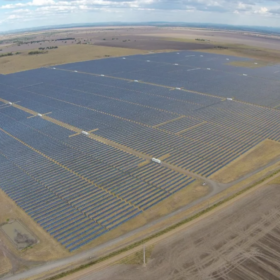
Construction has commenced on mining giant Fortescue’s 440 MW Solomon Airport solar farm being built in Western Australia’s Pilbara region. The facility, that is set to be the state’s largest solar development when complete, is due to commence operations in 2028.
Fortescue said the Solomon project will build on its solar generation portfolio and form a key part of a multi-gigawatt renewable energy supply that will power its Pilbara operations by the end of the decade.
The company wants to reach “real zero” at its Pilbara mines by 2030, which means burning no gas or diesel for its electricity supply, or for the land transport and drilling and hauling operations at the facilities.
“Across the Pilbara, we’re using the region’s sun and wind to generate green power for our sites,” Fortescue Metals and Operations Chief Executive Officer Dino Otranto said.
“We’re building the solar and wind farms, connecting them through our high-voltage transmission network and backing them with battery storage to provide 24/7 firm power.”
“Importantly, each successive solar project is being delivered more efficiently than the last. As technology improves and we gain scale, our installed capital intensity continues to come down – strengthening the economics of replacing diesel and gas with renewable energy.”
The beginning of the Solomon project build follows construction of the 190 MW Cloudbreak Solar Farm, which is about two-thirds complete.
Fortescue has also received all primary approvals for the up to 644 MW Turner River Solar Farm, with construction anticipated to commence later this year.
Once operational, the Solomon, Cloudbreak and Turner River projects, together with the existing 100 MW North Star Junction Solar Farm, will deliver about 1.3 GW of solar capacity.
Modelling suggests Fortescue will require 2-3 GW of renewable energy generation and battery energy storage capacity to achieve its 2030 target.
In addition to the solar projects, construction has also commenced on the 133 MW Nullagine Wind Farm and Fortescue has already installed more than 480 kilometres of high-voltage transmission lines across the Pilbara as part of its Pilbara Energy Connect (PEC) project. Once complete, the transmission network will extend to more than 620 km, physically linking Fortescue’s energy assets to its operations and rail network.
“Together, these projects represent one of the largest renewable energy deployments by any heavy industry company in Australia,” the company said.
Construction of the Solomon Airport Solar Farm is expected to be completed in 2028, with approximately 671,000 solar panels to be installed during the build.
This content is protected by copyright and may not be reused. If you want to cooperate with us and would like to reuse some of our content, please contact: editors@pv-magazine.com.



By submitting this form you agree to pv magazine using your data for the purposes of publishing your comment.
Your personal data will only be disclosed or otherwise transmitted to third parties for the purposes of spam filtering or if this is necessary for technical maintenance of the website. Any other transfer to third parties will not take place unless this is justified on the basis of applicable data protection regulations or if pv magazine is legally obliged to do so.
You may revoke this consent at any time with effect for the future, in which case your personal data will be deleted immediately. Otherwise, your data will be deleted if pv magazine has processed your request or the purpose of data storage is fulfilled.
Further information on data privacy can be found in our Data Protection Policy.