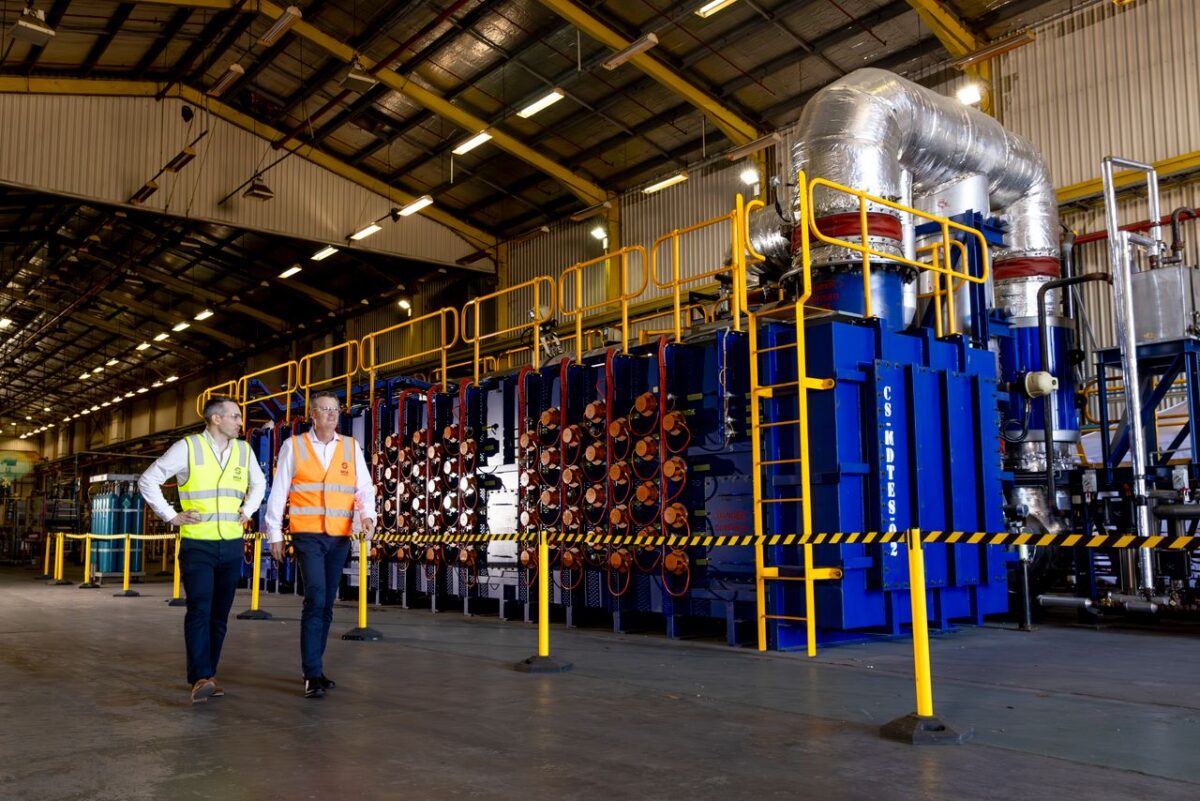





MGA Thermal announced it has secured $17 million (USD 11.9 million) in new investment to advance its long-duration thermal energy storage (TES) technology aimed at decarbonising industrial heat.
Newcastle-based MGA said the capital raise, led by venture capital firm IP Group Australia, will support its transition from pilot deployments to a full commercial rollout of its electro-thermal energy storage solution, including expanding its workforce, scaling manufacturing, and fast‑tracking new customer projects over the next two years.
“We are entering a period of rapid scale‑up, expanding our commercial capability, growing manufacturing, and delivering projects that help industry decarbonise at speed,” MGA Chief Executive Officer Mark Croudace said.
“Partnering with IP Group, alongside continued support from Main Sequence, gives us the global reach and deep‑tech expertise we need.”
MGA’s TES solution is centred around its patented miscibility gap alloy (MGA) block technology, which stores energy as latent heat in blocks made largely from aluminium and graphite and dispatching it to generate electricity.
When heated by renewable electricity, the metal alloy particles melt and absorb energy through a solid-to-liquid phase change. The stored energy can then be released as continuous industrial-grade steam, providing a potential alternative to fossil fuel heat in sectors such as manufacturing and processing.
The company said its storage blocks can deliver 200% more energy than conventional heat storage systems, with a footprint up to 24 times smaller than batteries.
“MGA Thermal is addressing one of the most critical challenges in the energy transition: delivering reliable, low‑cost, industrial‑scale storage for renewable heat,” IP Group Investment Manager Shane Meaney said.
“Industrial heat is the next frontier of decarbonisation, MGA’s technology delivers it 24/7 for less. We’re excited to support the team moving into full commercial deployment and look forward to partnering closely with MGA Thermal through this next phase of growth.”
The new investment follows a series of major milestones for MGA, including the launch of a 5 MWh thermal demonstration unit at the company’s Tomago headquarters and the completion of a pre-feasibility study that found its technology is economically competitive with traditional fossil fuel technologies.
The study investigated the feasibility of a 180 MWh TES project capable of delivering 20 tonnes per hour of steam to an industrial site in Western Australia. The planned project was found to be economically competitive with traditional heating methods on an industrial scale.
It also comes after the company was last month awarded $3.25 million in federal government funding via the Australian Renewable Energy Agency to support up to five front-end engineering design (FEED) studies to accelerate the commercialisation of its TES technology.
This content is protected by copyright and may not be reused. If you want to cooperate with us and would like to reuse some of our content, please contact: editors@pv-magazine.com.




By submitting this form you agree to pv magazine using your data for the purposes of publishing your comment.
Your personal data will only be disclosed or otherwise transmitted to third parties for the purposes of spam filtering or if this is necessary for technical maintenance of the website. Any other transfer to third parties will not take place unless this is justified on the basis of applicable data protection regulations or if pv magazine is legally obliged to do so.
You may revoke this consent at any time with effect for the future, in which case your personal data will be deleted immediately. Otherwise, your data will be deleted if pv magazine has processed your request or the purpose of data storage is fulfilled.
Further information on data privacy can be found in our Data Protection Policy.