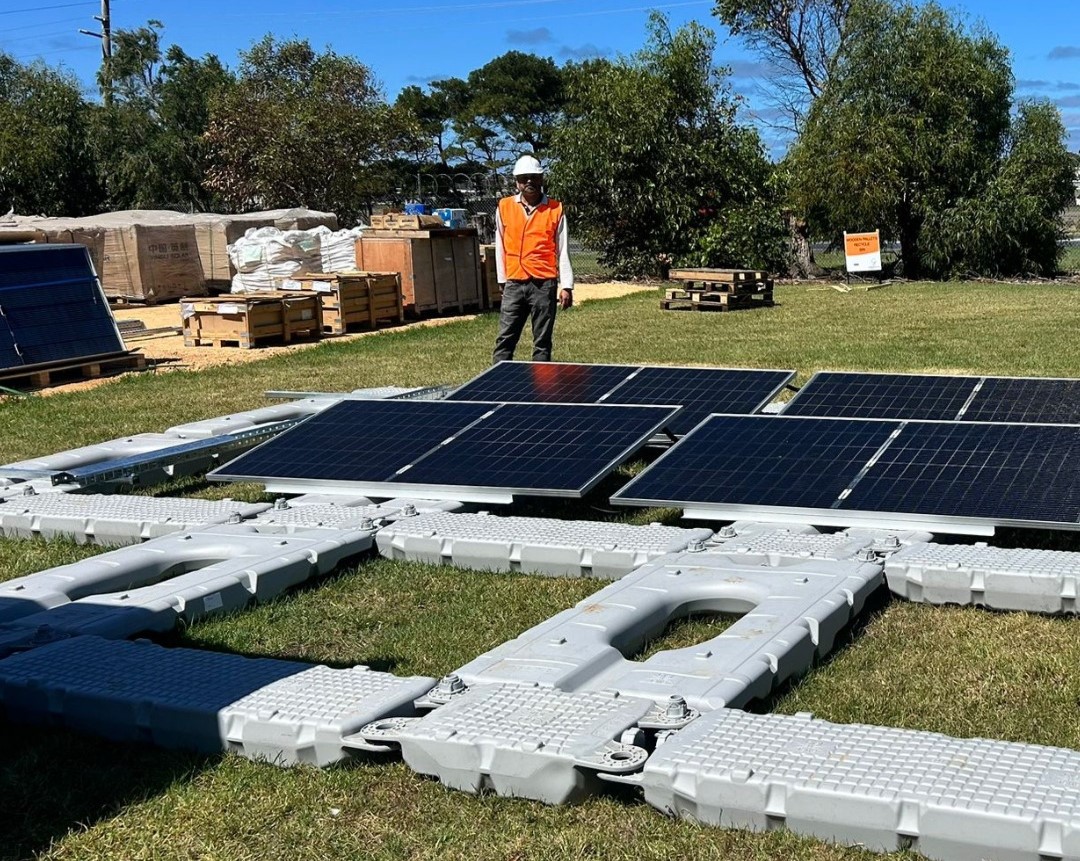





Melbourne-headquartered renewables developer Enervest announced that works have officially commenced on a 500 kW floating solar array being installed for Victoria government-owned authority Wannon Water on the Brierly Basin water storage reservoir in the regional city of Warrnambool.
“We’re excited to see construction underway and look forward to sharing progress as the project takes shape,” Enervest said.
The $2 million (USD 1.4 million) project, first announced in 2022, is to feature about 1,200 bifacial panels mounted on pontoons floated on Brierly Basin. The use of bifacial modules is expected to achieve approximately 20% better energy production due to the reflection of light from the water’s surface.
The pontoons will include integrated walkways while cables will secure the floating array to anchors placed at the bottom of the reservoir. The anchoring system has been designed to allow the pontoons to rise and fall with the changing level of the reservoir.
Wannon Water said once complete, the power plant will generate more than 600,000 kWh of renewable energy annually, significantly cutting its electricity costs at the Brierly Basin site.
“We use a lot of electricity to pump the water stored in Brierly Basin up to the Warrnambool Water Treatment Plant, making on-site solar a very attractive alternative,” the water authority said, adding that the business case shows the project will have a net-positive value of more than $500,000.
The floating solar array is also expected to reduce the water authority’s greenhouse gas emissions by more than 600 tonnes per year while other potential benefits include a reduction in sunlight entering the water at Brierly Basin, helping to minimise algae growth, and reduced evaporation rates.
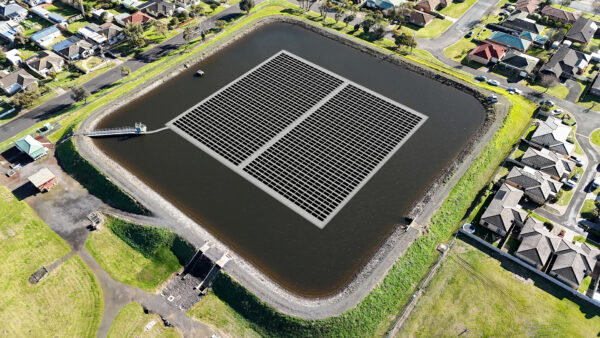
Image: Wannon Water
Launched by the state government as part of its push for all Victorian water companies to reach net zero emissions by 2045, the Brierly Basin system will upon completion be the largest floating solar plant.
While the technology is gaining acceptance worldwide, its adoption in Australia has been comparatively slow but there are signs of increased interest.
Operational systems include the 350 kW floating array deployed by Gippsland Water at the Drouin wastewater treatment plant, in Victoria’s east, and a 50 kW system installed by community group Gippsland Climate Change Network on a lake at exhibition venue Lardner Park in the state’s southeast.
Other systems include a 100 kW floating solar array installed at the East Lismore Sewage Treatment Plant in northern New South Wales and a 157 kW array at the Jamestown wastewater facility in South Australia.
This content is protected by copyright and may not be reused. If you want to cooperate with us and would like to reuse some of our content, please contact: editors@pv-magazine.com.




By submitting this form you agree to pv magazine using your data for the purposes of publishing your comment.
Your personal data will only be disclosed or otherwise transmitted to third parties for the purposes of spam filtering or if this is necessary for technical maintenance of the website. Any other transfer to third parties will not take place unless this is justified on the basis of applicable data protection regulations or if pv magazine is legally obliged to do so.
You may revoke this consent at any time with effect for the future, in which case your personal data will be deleted immediately. Otherwise, your data will be deleted if pv magazine has processed your request or the purpose of data storage is fulfilled.
Further information on data privacy can be found in our Data Protection Policy.