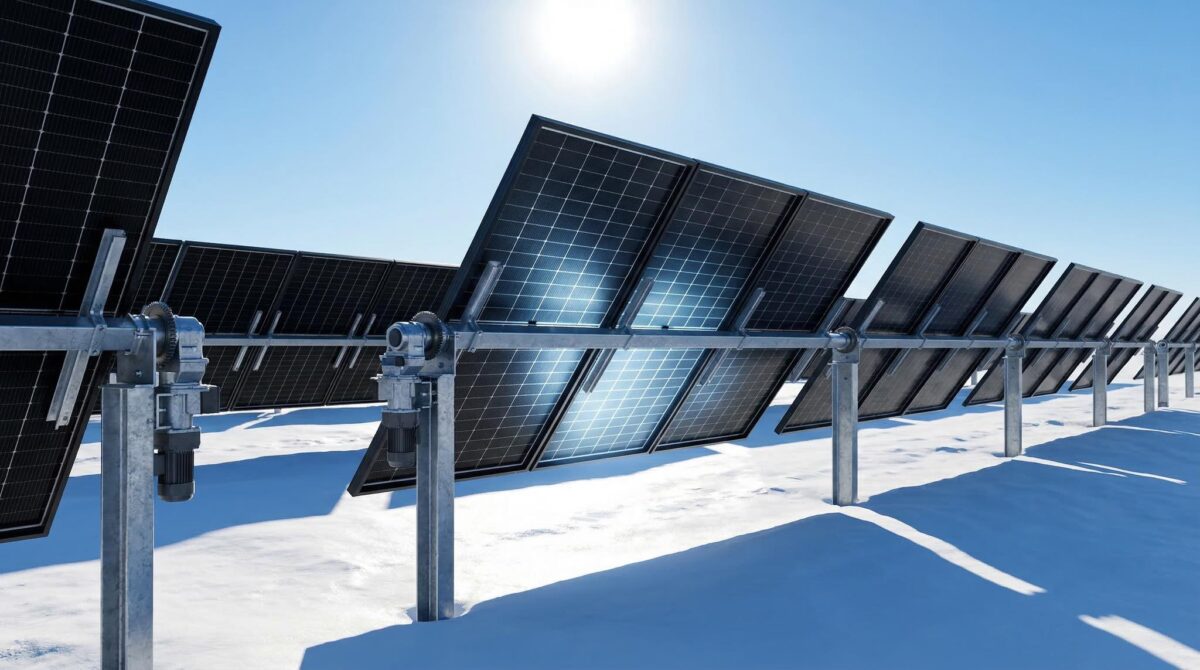





Chinese clean energy technology manufacturer JinkoSolar said its new AIDC (artificial intelligence data centre) modules are built on its Tiger Neo 3.0 tunnel oxide passivated contact (TOPCon) platform and offer front-side efficiency of 24.8% and a power output of 670 W or more.
JinkoSolar also highlighted the modules’ high bifaciality of about 85%, saying the power generated from the rear side effectively provides “free computing capacity expansion.”
“Taking a 670 W module with an 85% bifaciality ratio as an example, under ground-reflectance conditions of 0.26, the total output power can reach 844 W,” the company said. “For every 1 W of front-side power cost paid by the user, they actually obtain 1.26 W of total power generation capacity.”
JinkoSolar said the AIDC modules are specifically designed for the high power demands of conventional and AI-driven data centres, graphics processing unit clusters, supercomputing facilities, and semiconductor manufacturing units.
The modules have been optimised for low-irradiance conditions, with JinkoSolar saying even in extreme low-light scenarios such as dense fog or building shading, their relative power output remains stable at 95%–98%.
“The power generation curve better aligns with data centres’ long-term, round-the-clock, stable, and smooth power consumption needs,” the company said, adding that the modules are designed to maximise roof and land utilisation while minimising levelised cost of electricity (LCOE) across the full lifecycle.
JinkoSolar said the new product has successfully passed the 55 mm hail impact test, far exceeding conventional 25 mm standards, with high-strength tempered glass and shock-absorbing encapsulation ensuring reliable performance under extreme weather conditions.
On safety, JinkoSolar said the AIDC modules comply with stringent fire resistance standards, including IEC 61730-2:2023 and UL 790 Class A, and incorporate flame-retardant materials and arc-resistant technologies to reduce fire risk.
The launch of the new modules follows the release last week of a new national interest framework for data centres and AI being built in Australia.
The framework sets out five expectations data centres developments must meet, including prioritising Australia’s national interest, using water sustainably and responsibly, investing in local skills and jobs, and strengthening research, innovation and local capability.
The new framework also requires data centre and AI infrastructure developers to strongly support the country’s clean energy transition.
The release of the framework comes as data centre growth continues to accelerate in Australia with the Australian Energy Market Operator (AEMO) forecasting that data-centre power demand could triple in five years.
Data centres now draw about 2% of electricity from the National Electricity Market, consuming about 3.9 TWh of electricity in 2025. AEMO expects that share to grow at an average annual rate of 25.1% to reach 12 TWh, or 6% of grid demand, by 2030, and 34.5 TWh by 2050.
This content is protected by copyright and may not be reused. If you want to cooperate with us and would like to reuse some of our content, please contact: editors@pv-magazine.com.



By submitting this form you agree to pv magazine using your data for the purposes of publishing your comment.
Your personal data will only be disclosed or otherwise transmitted to third parties for the purposes of spam filtering or if this is necessary for technical maintenance of the website. Any other transfer to third parties will not take place unless this is justified on the basis of applicable data protection regulations or if pv magazine is legally obliged to do so.
You may revoke this consent at any time with effect for the future, in which case your personal data will be deleted immediately. Otherwise, your data will be deleted if pv magazine has processed your request or the purpose of data storage is fulfilled.
Further information on data privacy can be found in our Data Protection Policy.