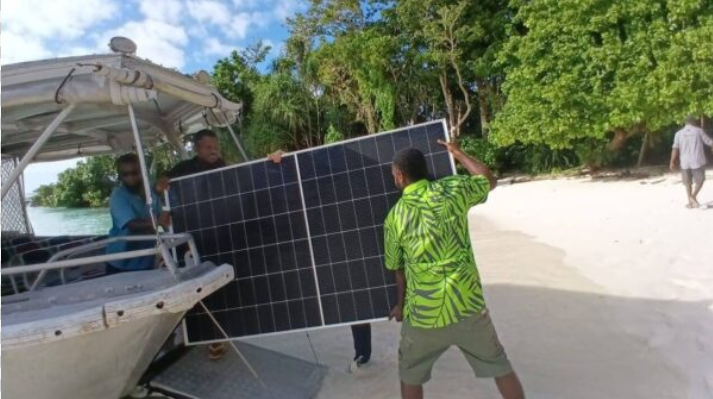





Ministers and senior officials from Tuvalu, Samoa, Fiji, Palau, Federated States of Micronesia, and Vanuatu have called for immediate transition to 100% renewable energy economies in the quest for a fossil free Pacific and express support for the global fossil fuel non-profileration treaty.
Attending the Port Vila II: PSIDS Ministerial Dialogue on the Global Just Transition, the country’s representatives launched the Tassiriki Call for a Fossil Free Pacific (the Call), a declaration to establish a regional transition framework and commit participating nations to a coordinated diplomatic strategy to advance the adoption of a global Fossil Fuel Non-proliferation Treaty across all regional and international forums.
Treaty
The Treaty would be a binding international mechanism to manage a just, orderly, equitable, and rapid phase-out of coal, oil, and gas, and declares the importance of implementing a fully-funded 100% renewable energy strategy for the Pacific, while calling for scaled-up, grant-based finance that does not increase the region’s debt burden.
Vanuatu Minister of Climate Change, Adaption, Meteorology and Geo-Hazards Ralph Regenvanu said the fossil fuel-driven energy crisis is not just an environmental disaster; it is an economic and security threat to the region’s existence.
“The Tassiriki Call for Fossil Fuel Free Pacific is our blueprint for survival and prosperity. It is a unified message from the frontline of the climate crisis: the age of fossil fuels must end, and the world must heed our call for a global, just, and equitable phase-out through a Fossil Fuel Treaty,” Regenvanu said.
The declaration puts pressure on major developed nations, particularly Australia, co-host of the upcoming COP31, and which continues to approve new coal and gas projects despite regional calls for a phase-out.
Tuvalu Minister for Home Affairs, Environment and Climate Change Dr Maina Talla said the declaration marks the beginning of the next chapter of the Pacific’s journey to a fossil free future – setting a clear direction for the unified coalition of countries who are ready to secure a fast, fair and financed transition away from coal, oil and gas production.
“Next week, we will join over 55 countries in Santa Marta, Colombia where we will aim to scale unprecedented levels of international cooperation and advance the proposal to negotiate a Fossil Fuel Treaty,” Talla said.
Key demands
As well as a transition to 100% renewable energy economies and the Fossil Fuel Treaty, the Tassiriki Call key demands and commitments include that the 1.5°C global heating threshold be non-negotiable, stating that the survival of Pacific peoples depends on maintaining this limit.
The Call seeks to strategically deploy the landmark advisory opinion of the International Court of Justice (ICJ), which affirmed that a state’s failure to act on fossil fuel production and subsidies may constitute an internationally wrongful act.
It calls on all nations to immediately cease fossil fuel exploration and expansion, end subsidies, and start the managed decline of existing production, with developed nations moving first and fastest.
The Call also expresses deep concern over technologies like Carbon Capture and Storage (CCS) and geoengineering being used to justify prolonged fossil fuel production, stating they “risk diverting finance, political attention and time away from proven pathways.”
Lastly, it agrees to formally establish an Inter-Governmental Taskforce for a Just Transition to a Fossil Fuel Free Pacific to carry forward these outcomes, focusing on legal pathways, governance, and financial mechanisms.
Tassiriki Call for a Fossil Fuel Free Pacific
Adopted on April 15, 2026, in Port Vila, Vanuatu, the Tassiriki Call for a Fossil Fuel Free Pacific follows-on from the unprecedented impact of two Category 4 cyclones that struck Vanuatu within the same week in 2023.
Today, the movement toward a Fossil Fuel Free Pacific has grown to 18 countries, more than 150 subnational governments, 4,000 civil society organisations, and over one million individual endorsees worldwide.
Tassiriki is a suburb of Port Vila, Vanuatu.
This content is protected by copyright and may not be reused. If you want to cooperate with us and would like to reuse some of our content, please contact: editors@pv-magazine.com.






By submitting this form you agree to pv magazine using your data for the purposes of publishing your comment.
Your personal data will only be disclosed or otherwise transmitted to third parties for the purposes of spam filtering or if this is necessary for technical maintenance of the website. Any other transfer to third parties will not take place unless this is justified on the basis of applicable data protection regulations or if pv magazine is legally obliged to do so.
You may revoke this consent at any time with effect for the future, in which case your personal data will be deleted immediately. Otherwise, your data will be deleted if pv magazine has processed your request or the purpose of data storage is fulfilled.
Further information on data privacy can be found in our Data Protection Policy.