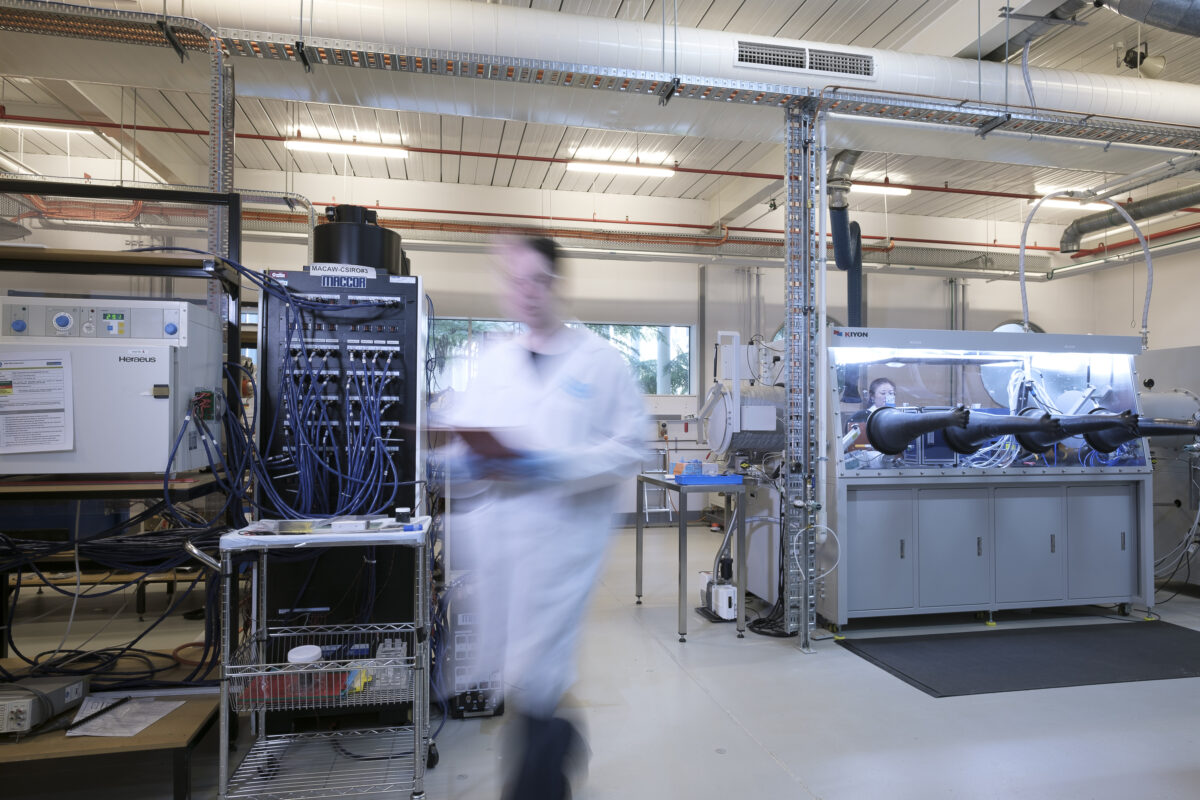





Climate tech now ranks among Australia’s fastest-growing funded sectors. Global investors are circling. The opportunity is real. And the urgency has never been more real — rising petrol prices, supply chain pressures, and soaring electricity costs have made the energy transition personal for everyday Australians. The question now is whether we have the sovereign capability to deliver this infrastructure at national scale — because that conversation is already driving policy and investment at the highest levels of government.
Investment alone won’t close the gap between a lab breakthrough and a deployed solution. If we want to accelerate the energy transition and meet long-term decarbonisation goals, we need to move faster — and more deliberately.
A sector on the rise
Five years ago, few would have predicted that climate tech would be competing with AI for the top spot in Australian venture funding. Today, the sector spans breakthroughs in energy storage, grid reliability, hydrogen and risk management, attracting serious attention from global investors who recognise what Australia has to offer: deep research capability, natural resources, and a growing ecosystem of founders ready to build.
With $680 million invested in 2025 alone, the capital is clearly there. But the window is competitive and time sensitive. The countries and companies that move fastest from discovery to deployment will capture the jobs, the export revenues, and the industrial base that the energy transition creates. There is a real opportunity to build industries and deliver impact at scale from publicly funded energy research — if we close the gap between lab and market.
The innovation bottleneck
Some argue that Australia already has enough accelerators and grant programs — that the pipeline is well supported and the private sector should do the heavy lifting from here. That view mistakes activity for infrastructure. The challenge isn’t a shortage of individual programs or willing investors; it’s that the system isn’t set up to consistently translate research into market-ready outcomes. Lengthy IP negotiations, conservative risk settings, and limited institutional support for founders all slow progress at the very point where momentum is needed most.
Translating lab innovations into real-world solutions is complex and time-intensive, and funding alone doesn’t solve it. Early-stage projects often stall not because the science is weak, but because the pathways from lab to market are fragmented or unclear. The system itself — not the researchers within it — is where the gap exists.
The missing piece is structural. Research translation requires staged, tiered support: different guidance for a concept still being proven than for a venture ready to raise capital. Early-stage researchers need help testing assumptions and identifying potential customers; more advanced teams need coaching on pitching, partnerships, and scale. Investment in publicly funded research at scale demands more than grant dollars. It requires the translation infrastructure — mentorship, market validation, and commercial coaching — that turns a breakthrough into a business.
Early market validation unlocks impact
Early validation — engaging potential users, testing assumptions, iterating quickly — is often the most effective way to translate research into real-world impact. Structured feedback before significant capital is committed can save years of misdirected effort. And the evidence is clear: doing this early work materially improves the likelihood of success and long-term venture survival, dramatically increasing the odds that what eventually reaches market is something the world actually needs.
The results from our ON Program speak for themselves — alumni have collectively secured over $870+ million in funding across commercialisation grants and new ventures. MGA Thermal, Facet Amtech and HydGene Renewables each moved from research concept to commercial milestone through structured translation support — validating markets early, building investor readiness, and securing significant follow-on funding. MGA Thermal has since gone on to raise $14 million to scale its industrial capabilities. HydGene raised a $6 million seed round and secured a $2 million NSW Biosciences Fund Grant to scale biocatalyst manufacturing, while Facet Amtech built the world’s first air-feeding ammonia reactor, a genuine proof point for green energy systems.
Together, these aren’t isolated wins. They demonstrate what structured translation support does at a system level: compressing the time from idea to investor-ready venture, reducing capital risk through early validation, and building the commercial credibility that attracts downstream funding. These are replicable outcomes — not exceptions.
The opportunity is now
Australia has the research depth, funding momentum and technical ambition to lead the next wave of climate-tech deployment. What will determine whether that promise is realised is how quickly ideas move beyond the lab.
For researchers, that means engaging earlier with market validation — testing assumptions, understanding users, and shaping solutions around real-world demand.
For investors, it means looking beyond technical novelty alone and backing teams that have de-risked their path to deployment through early customer insight and commercial readiness.
For institutions and governments, the task is structural: scaling stage-appropriate translation support, not just grants, so that publicly funded research can move faster and further.
The pipeline of climate-tech innovation is already deep. With the right translation infrastructure in place, Australia can convert world-class science into deployed solutions that deliver emissions reductions, industrial capability and economic value at the speed this moment calls for.
Author: Tennille Eyre, Executive Manager of Innovation Programs, CSIRO
The views and opinions expressed in this article are the author’s own, and do not necessarily reflect those held by pv magazine.
This content is protected by copyright and may not be reused. If you want to cooperate with us and would like to reuse some of our content, please contact: editors@pv-magazine.com.



By submitting this form you agree to pv magazine using your data for the purposes of publishing your comment.
Your personal data will only be disclosed or otherwise transmitted to third parties for the purposes of spam filtering or if this is necessary for technical maintenance of the website. Any other transfer to third parties will not take place unless this is justified on the basis of applicable data protection regulations or if pv magazine is legally obliged to do so.
You may revoke this consent at any time with effect for the future, in which case your personal data will be deleted immediately. Otherwise, your data will be deleted if pv magazine has processed your request or the purpose of data storage is fulfilled.
Further information on data privacy can be found in our Data Protection Policy.