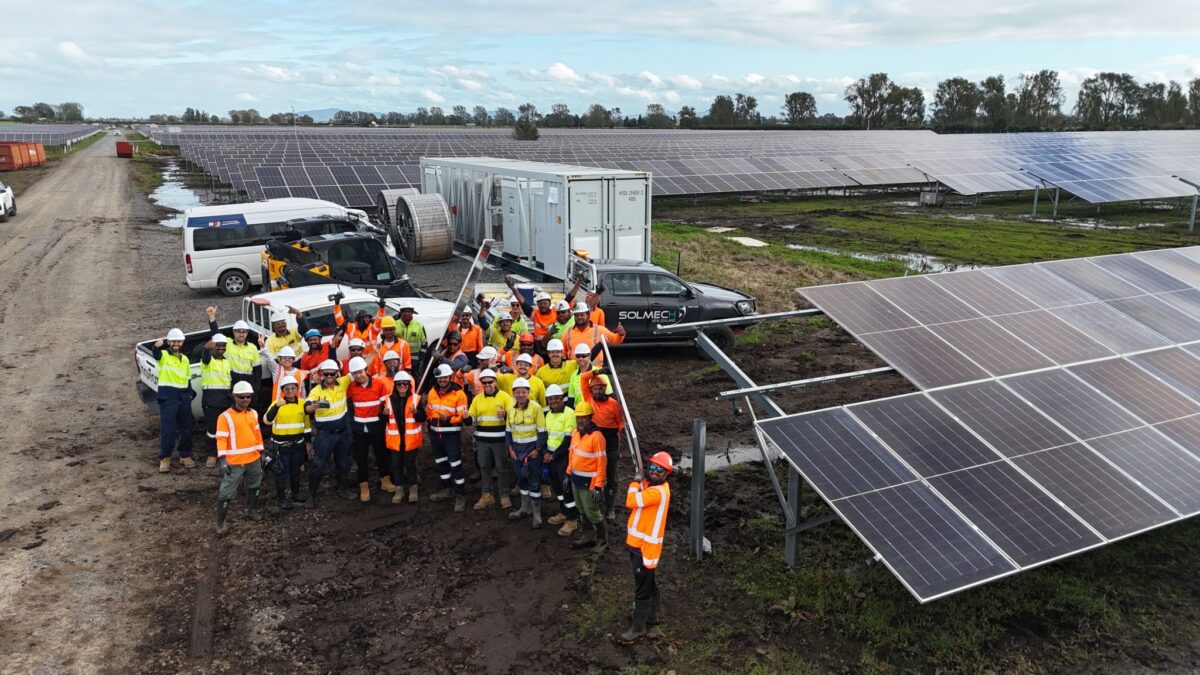





The 202 MWp Tauhei Solar Farm, a joint venture between British renewables developer Harmony Energy and New Zealand company First Renewables, is one step closer to operations after the final panel was successfully installed ahead of schedule at the North Island site.
Construction partner Elecnor announced that the last of 330,000 panels has been installed with the solar farm now moving towards energisation with commissioning expected in late 2026.
“Now, we head into the final phases of commissioning and energisation,” Elecnor said.
Harmony has previously indicated that the plan is to have the facility, being constructed on a 182-hectare site near Hamilton in the North Island’s northeast, fully operational by 2027.
Once complete, the 202 MW Tauhei project will generate about 280 GWh of renewable electricity annually, enough to power the equivalent of approximately 35,000 New Zealand homes.
The facility will connect to the national grid via Transpower’s 110 kV Waihou substation and is supported by a power purchase arrangement with gentailer Meridian Energy, which has signed a deal to purchase 100% of the output for the first 10 years of operation.
Harmony said the Tauhei project represents a major step forward in New Zealand’s renewable energy journey, supporting the transition toward a more sustainable and resilient power network.
“At the time of commissioning in late 2026, it will become New Zealand’s largest solar farm,” the company said, adding that the project “sets a benchmark for large-scale solar projects” and reinforces the growing role of solar in New Zealand’s renewable energy landscape.
The 63 MWp Lauriston Solar Farm west of Christchurch on New Zealand’s South Island is the nation’s largest operational solar farm but there are larger-scale projects in the pipeline, including the 400 MW Te Rahui Solar Farm being developed on the North Island by Nova Energy and Meridian Energy.
This content is protected by copyright and may not be reused. If you want to cooperate with us and would like to reuse some of our content, please contact: editors@pv-magazine.com.





By submitting this form you agree to pv magazine using your data for the purposes of publishing your comment.
Your personal data will only be disclosed or otherwise transmitted to third parties for the purposes of spam filtering or if this is necessary for technical maintenance of the website. Any other transfer to third parties will not take place unless this is justified on the basis of applicable data protection regulations or if pv magazine is legally obliged to do so.
You may revoke this consent at any time with effect for the future, in which case your personal data will be deleted immediately. Otherwise, your data will be deleted if pv magazine has processed your request or the purpose of data storage is fulfilled.
Further information on data privacy can be found in our Data Protection Policy.