




Electricity grids need inertia to maintain stability, but the way energy is now generated is making it harder to access.
Synchronous generators, the heavy rotating turbines in coal, gas, nuclear and hydropower plants can provide control room engineers with the inertia needed to maintain frequency for the electrical system. Replace coal with solar and the control room must find inertia somewhere else. It’s a significant problem.
Initial studies in the United Kingdom from 2012 already revealed that if the volume of non-synchronous generation exceeded about 65% of total generation capacity running, the transmission system could not be secured against some credible potential faults. Proponents argue power electronics can bridge the gap.
Grid forming vs. grid following
Field work
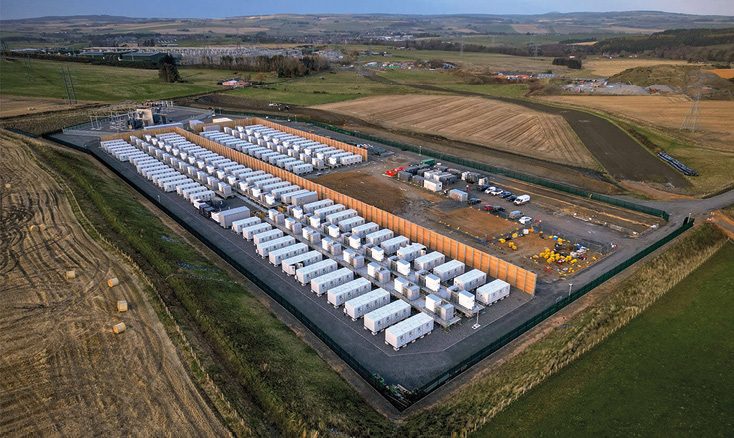
In a field roughly 70 km northwest of Aberdeen, once known as Europe’s oil capital, the Blackhillock BESS provides Great Britain’s electricity grid with synthetic inertia – the kind that doesn’t require any spinning mass. Grid-forming technology has been deployed in northeast Scotland to provide synthetic inertia and stability services to a part of the network where renewable generation from wind farms is abundant.
Developed by Zenobe and using energy storage provided by Wärtsilä Energy Storage, the 200 MW/400 MWh phase-one section of Blackhillock BESS was commissioned in early 2025, becoming the first battery in the world to provide full active and reactive power services connected to the transmission system. The landmark project is paid to provide grid stabilisation services to Great Britain’s National Energy System Operator, having passed various technical tests in the system operator’s Stability Pathfinder 2 procurement round. It’s able to offer these stability services due to innovative grid-forming technology provided by German inverter manufacturer SMA.
Blackhillock was supplied with 62 SMA medium-voltage power stations, each equipped with grid-forming inverters. The inverters provide 370 megawatt-seconds (MWs) of synthetic inertia and 116 megavolt amps (MVA) of short circuit level contribution. Deploying grid-forming technology at Blackhillock means the BESS project can stabilise voltage dips and phase jumps. Getting to this stage took a lot of work.
“From a hardware manufacturing point of view and from a cost point of view, there’s not much difference,” said Aaron Gerdemann, vice president global new business and marketing at SMA. “But the controls and complexity in the design process of the asset is many times higher.”
Gerdemann told pv magazine that a grid-forming BESS project requires extensive modeling, simulation work, close collaboration with the system operator and the tuning of many more parameters than a typical grid-following installation.
SMA sells its engineering services alongside its power conversion systems, a key point of difference according to Gerdemann who argued that the real test of grid-forming technology is deployment, when real performance meets simulations.
“The criteria of a good or bad grid-forming control is only realized when it’s connected and online,” he said.
Getting connected still involves jumping through some regulatory hoops. For Blackhillock, SMA had to achieve compliance with Grid Code 0137 – the regulation that sets minimum specifications for grid-forming capability on Great Britain’s electricity grid. This is one of the advanced markets, however, and rules for incorporating grid-forming inverters are at different stages globally. Germany’s transmission system operators (TSOs) started procuring inertia in January 2026. Even in a smaller market such as the Philippines, a new energy storage mandate announced in February 2026 included a call to develop guidelines for BESS with grid-supporting capabilities. This would see the country join a small but growing list of markets where grid-forming technology has been codified.
“We have now worldwide very few grid codes with grid forming,” Gerdemann said. “They are unfortunately not the same.”
SMA is actively consulting with different TSOs, Gerdemann confirmed, with some grid operators reaching out to ask for the inverter manufacturer’s assessment of their grid code. SMA would like to see grid codes introduced that do not mandate grid-forming for every BESS installation but would instead prefer high standards for grid-forming assets deployed at key anchor sites on the network, and always in combination with a stability market incentive.
What can grid-forming inverters do?
Building momentum
Demand for grid-forming inverters is mixed among leading renewables markets worldwide. Tiffany Wang, research analyst at S&P Global Energy, described Australia as one of the most mature markets – with front-of-meter grid-forming BESS potentially accounting for nearly 100% of installations by 2030. This is in contrast to major renewables markets such as China and the United States, where there is less deployment.
“Saudi Arabia and Chile represent newer grid-forming inverter markets and are expected to reach high penetration rates very quickly,” Wang said. “While there are relatively few grid-forming BESS projects currently, they are very large in scale and spearheaded by top Chinese inverter companies.”
Large-scale projects include a three-site, 7.8 GWh project in Saudi Arabia supplied by Sungrow. The Chinese manufacturer has validated its grid-forming Power Titan 3.0 at the project, and in January 2026 held a European launch event for the energy storage platform in Madrid, Spain.
James Li, vice president for Europe at Sungrow, said the company has also been conducting a live test at a transmission connected site in Tibet.
There are local variables to consider for each project, but Li explained that testing in the lab can ensure grid-forming algorithms are tuned to the project’s needs.
“We normally do a lot of in-house testing in the beginning, particularly for the control system” he said. “I think in Saudi Arabia, the thing we most needed to fully understand was the control algorithm, because there are a few different control algorithms.”
Li explained that grid-forming inverters can use droop control or virtual synchronous generator (VSG) algorithms to govern inverter output. Both are methods for mimicking the rotor characteristics of synchronous generators.
“We often take the responsibility to ensure the performance of the entire BESS energy management system by organizing with the customer to bring all the BESS plant suppliers’ energy management equipment to the Sungrow testing lab to verify, check and approve everything, with hardware in loop to do the testing at the front,” he said.
Sungrow is not the only Chinese manufacturer expanding into grid forming. Huawei announced its grid-forming FusionSolar 9.0 solar-plus-storage platform at the 2025 SNEC exhibition in Shanghai, while Hithium teamed up with Schoenergie to deploy a 55 MWh grid-forming BESS project in Germany. Battery giant CATL has included high-voltage grid-forming storage in its plans for the off-grid zero-carbon industrial park in Shandong, China.
Synchronous condensers
Expanding in Australia
Manufacturers looking for a test bed for their new grid-forming products might want to take a trip Down Under. Australia has spent years investigating the role grid-forming inverters could play in shoring up an increasingly renewables reliant grid. Geography poses a challenge here, due to a long network serving sparsely populated communities, weak grid areas and rapidly growing renewable generation.
The Australian Renewable Energy Agency (ARENA) is one of the agencies funding projects to improve system resilience, and grid-forming technology has been a major focus for nearly a decade.
“Back in 2017, ARENA funded the Dalrymple battery, which is owned by transmission company ElectraNet. At the time grid forming was largely unheard of,” explained Carl Christiansen, general manager for grid and storage at ARENA. “It had to island a peninsula, and [inverter manufacturer] ABB engineered a solution they called a ‘virtual synchronous generator,’ which mimicked operation characteristics of a traditional synchronous generator.”
The 30 MW/ 8 MWh Dalrymple BESS was commissioned on Dec. 14, 2018, with a grid-forming inverter intended to island the Wattle Point Wind Farm with the Yorke Peninsula, a sparsely populated area of South Australia. Dalrymple was deemed a success and ARENA opted to take things further. From 2019 to 2021 ARENA provided funding to test how synthetic inertia and system strength services from inverters could support the grid across four more projects. This included retrofitting the oldest utility-scale battery on Australia’s NEM wholesale electricity market, Hornsdale BESS, adding 50 MW/ 64.8 MWh capacity and implementing battery supplier Tesla’s virtual machine mode to provide virtual inertia services.
This process allowed ARENA to test grid-forming inverter tech in weaker and stronger parts of the grid, inform regulations to make deployment more straightforward, and provide an on ramp for manufacturers for grid-forming products that were in development.
“A lot of companies said they had grid-forming products. They had brochures and models, but they weren’t actually ready to meet connection standards,” Christiansen said. “A big part of what we did was push those products from theory into something that could actually get approved.”
There are benefits for solar developers too, as utility-scale plants were being required to bring their own inertia with expensive synchronous machines. Grid-forming inverters can reduce costs.
ARENA is now backing even bigger projects. The agency has launched a $100 million (USD 70 million) program with the objective of funding projects that can demonstrate advanced inverter technology at scale. The 540 MW/ 1080 MWh Western Downs has already been commissioned with three more projects expected to come online in 2026. These will join the five ARENA funded grid-forming battery projects with a combined rating of 430 MW that are already operational for a total ARENA operating portfolio of 2 GW.
“It’s actually a huge success that this technology has come so far so quickly,” Christiansen said.
This content is protected by copyright and may not be reused. If you want to cooperate with us and would like to reuse some of our content, please contact: editors@pv-magazine.com.

By submitting this form you agree to pv magazine using your data for the purposes of publishing your comment.
Your personal data will only be disclosed or otherwise transmitted to third parties for the purposes of spam filtering or if this is necessary for technical maintenance of the website. Any other transfer to third parties will not take place unless this is justified on the basis of applicable data protection regulations or if pv magazine is legally obliged to do so.
You may revoke this consent at any time with effect for the future, in which case your personal data will be deleted immediately. Otherwise, your data will be deleted if pv magazine has processed your request or the purpose of data storage is fulfilled.
Further information on data privacy can be found in our Data Protection Policy.