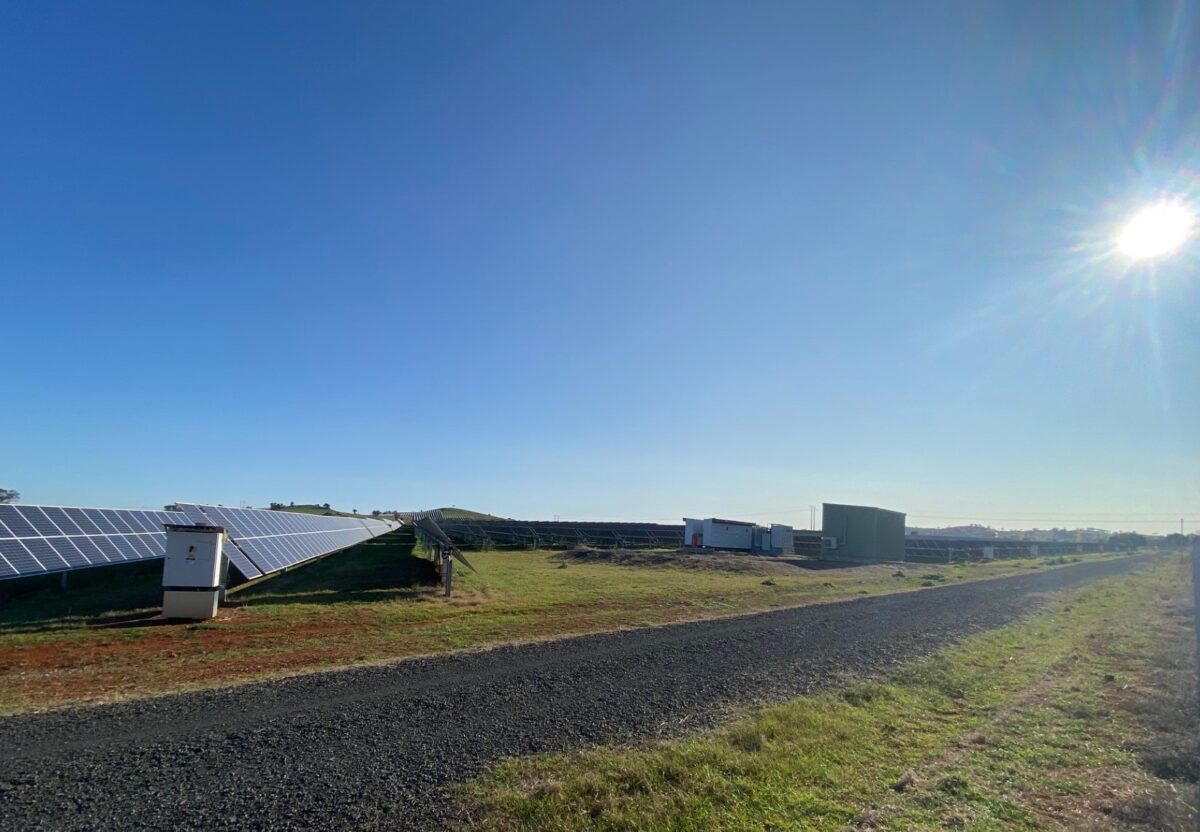





Data released by the Clean Energy Council (CEC) shows renewables investment strengthened in the last quarter of 2025 with five large-scale solar and wind projects representing 1.2 GW of new generation capacity and $3.5 billion (USD 2.48 billion) in value reaching financial close.
The CEC’s Quarterly Investment Report: Large-scale renewable generation and storage (Q4 2025) also shows that five energy storage projects totaling 1.1 GW / 2.8 GWh capacity reached financial close during Q4 2025, with total capital investment exceeding $4 billion across generation, storage and hybrid assets.
The result is the second-highest investment total recorded in a single quarter, behind only Q4 2022 when capital investment reached $4.3 billion, but follows “subdued” investment activity in the prior three quarters.
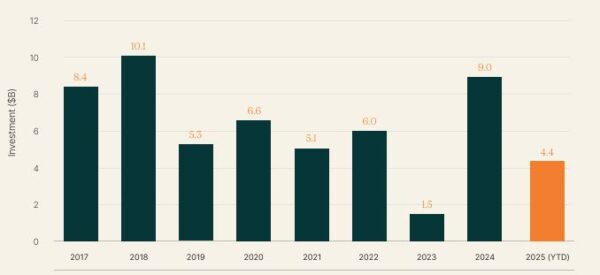
Image: CEC
Total capital expenditure for renewable energy generation projects reaching financial close in 2025 reached $4.4 billion, down from $9 billion in 2024, while the power capacity of those new financial commitments was 2.3 GW, down from 4.4 GW in 2024, according to the report.
CEC Chief Executive Officer Jackie Trad said the late surge in financial commitments signals renewed investor confidence but warned maintaining a high rate of renewables growth required faster transmission rollout, planning approvals and grid connections in all states and territories.
“The seasonal rush to close out on projects before years’ end, together with more political stability in the second half of 2025, ended the year on a stronger note than where it started,” she said.
“However, there is still much work to be done to accelerate future investment in large-scale generation. This must include streamlining planning and approval processes and delivering the transmission infrastructure required to connect projects to the National Electricity Market (NEM).”
Trad said the late boost to investment in Q4 2025 coincided with a host of major milestones across the NEM towards the end of last year.
“The final quarter of last year saw many new renewables records broken,” she said, noting that more renewable electricity was switched on in the final quarter of 2025 than in any other quarter on record.
“Sixty-three per cent of total renewable generation capacity that was switched on in 2025 was delivered in Q4,” Trad said. “That scale of projects being commissioned in a single quarter is an Aussie first.”
“In addition, renewable energy supplied over half (51%) of all electricity in the NEM for the first time during Q4 2025 and reached up to 77% of peak demand when the grid was pushed to its limits during January’s extreme heatwaves.”
The report shows a record nine large-scale solar and wind projects were switched on during Q4 2025, delivering 2.1 GW of new generation capacity, 57% more than the previous record of 1.3 GW set in Q3 2021. This surge of generation projects becoming commissioned meant 3.3 GW of generation capacity came online in 2025.
A record four utility-scale battery projects totalling 1 GW / 2.3 GWh also became operational in Q4, beating the mark set in Q3 2025.
The CEC also said the forward pipeline remains robust with 81 generation projects totalling nearly 13 GW, and 75 storage projects representing 13 GW / 34.7 GWh of new capacity either financially committed or under construction.
South Australia led the nation with the fastest average time from financial commitment to commissioning – 19 months for solar farms and 23 months for onshore wind. South Australia and Victoria were tied for the quickest battery development timelines, averaging 20 months.
Queensland commissioned the most renewable energy projects in Q4 last year with four projects coming online but it continued to have the longest delivery timelines: 23 months for solar, 37 months for wind, and 28 months for utility-scale batteries.
This content is protected by copyright and may not be reused. If you want to cooperate with us and would like to reuse some of our content, please contact: editors@pv-magazine.com.



By submitting this form you agree to pv magazine using your data for the purposes of publishing your comment.
Your personal data will only be disclosed or otherwise transmitted to third parties for the purposes of spam filtering or if this is necessary for technical maintenance of the website. Any other transfer to third parties will not take place unless this is justified on the basis of applicable data protection regulations or if pv magazine is legally obliged to do so.
You may revoke this consent at any time with effect for the future, in which case your personal data will be deleted immediately. Otherwise, your data will be deleted if pv magazine has processed your request or the purpose of data storage is fulfilled.
Further information on data privacy can be found in our Data Protection Policy.