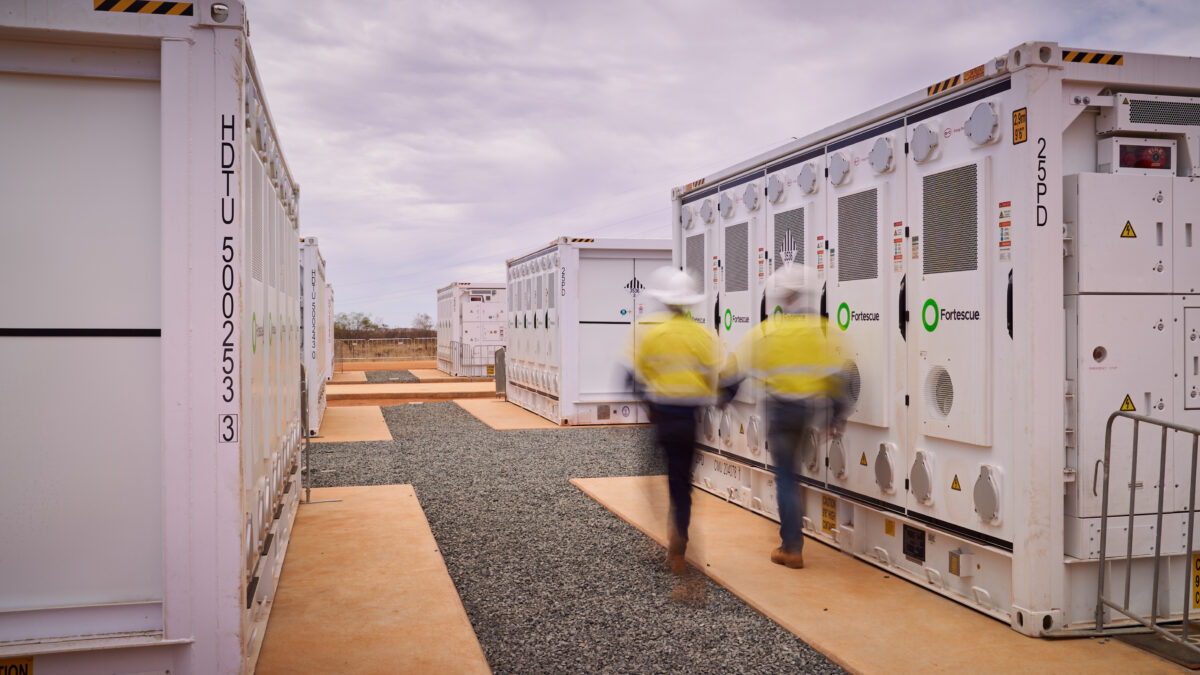





Batteries are maintaining a strong lead in the race for renewable energy pipeline growth, indicated by the Australian Energy Market Operator’s (AEMO’s) latest quarterly Connections Scorecard showing 67.3 GW of projects are progressing through the National Electricity Market (NEM) connection process.
Batteries account for around half of the total pipeline capacity with around 73 GW of generation and storage capacity (excluding consumer energy resources) installed in the NEM.

Image: Australian Energy Market Operator
AEMO Onboarding and Connections Group Manager Margarida Pimentel said the overall project pipeline has increased 33% from 50.5 GW at the end of Q1 2025 to 67.3 GW in Q1 2026.
“There is positive momentum across the connections pipeline, with strong growth in projects progressing through the early stages of the application process,” Pimentel said.
“Projects in application stage, where the performance of project design is assessed, increased by 51% over the past year, from 19.7 GW to 29.8 GW, with 18 projects totalling 5.5 GW in the March quarter alone.”
Pimentel said there is a continued trend of projects taking longer in the proponent implementation phase, due to prolonged funding uncertainty, project ownership changes, supply chain and resource constraints, and design modifications.
“What’s important is that these projects continue through to registration and commissioning to full output, so they can support reliability and the transition of the power system,” Pimental said.
The new capacity will help meet an anticipated 28% rise in electricity demand by 2035, while also offsetting the planned retirement of 11 GW of predominantly coal‑fired power stations over the next 10 years, including Eraring, Bayswater and Vales Point (NSW), Yallourn (VIC), and Callide B (QLD).
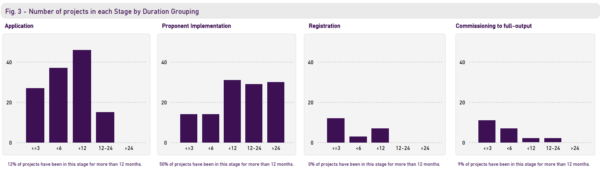
Image: Australian Energy Market Operator
By technology type over the past year, standalone battery capacity in the pipeline increased from 20.5 GW to 33.2 GW, while grid-scale solar rose from 17.7 GW to 20.7 GW and wind from 8.32 GW to 9.75 GW. Hydro remained stable at 3 GW, while gas capacity decreased by 74% from 0.9 GW to 0.2 GW, with the Hunter Power Station commissioning to full output.
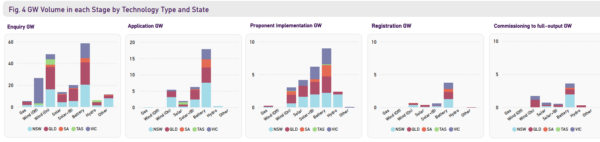
Image: Australian Energy Market Operator
Batteries now comprise 49% cent of total capacity in the NEM connections pipeline, with around 74% of battery projects being grid-forming.
For the March 2026 quarter, eight projects totalling 1.4 GW received application approvals, eight projects totalling 1.5 GW were registered, and five projects totalling 1.4 GW reached full output, including:
- Hunter Power Station (660 MW)
- Clarke Creek Wind Farm (440 MW)
- Swanbank Battery Energy Storage System (250 MW / 500 MWh)
- Limondale Battery Energy Storage System (50 MW / 400 MWh)
- Wangaratta Solar Farm (22 MW)
This content is protected by copyright and may not be reused. If you want to cooperate with us and would like to reuse some of our content, please contact: editors@pv-magazine.com.


By submitting this form you agree to pv magazine using your data for the purposes of publishing your comment.
Your personal data will only be disclosed or otherwise transmitted to third parties for the purposes of spam filtering or if this is necessary for technical maintenance of the website. Any other transfer to third parties will not take place unless this is justified on the basis of applicable data protection regulations or if pv magazine is legally obliged to do so.
You may revoke this consent at any time with effect for the future, in which case your personal data will be deleted immediately. Otherwise, your data will be deleted if pv magazine has processed your request or the purpose of data storage is fulfilled.
Further information on data privacy can be found in our Data Protection Policy.