Autonomous robot module installation trial fast tracks Victorian solar farm
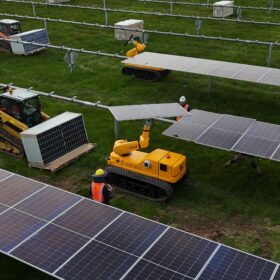
The installation of almost 500,000 solar panels at Victorian solar farm will be completed this week, thanks in part to a collaboration with US robotics company Luminous, which has trialled its autonomous fleet at the site, during the construction phase.
Why data-driven planning will shape the success of Australia’s 2035 climate goals
Achieving Australia’s 2035 energy goals needs engineering firms to have project intelligence at their fingertips, through unified, real-time data about a project, its people, and finance, to ensure accurate forecasting, avoid delays and maximise performance.
Singlet fission research breakthrough unlocks high solar cell efficiency
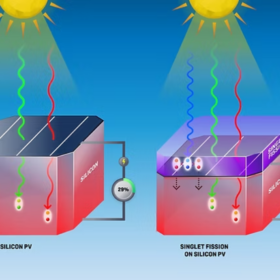
University of New South Wales researchers have filed patent protection and are working to scale production of a new class of photostable organic molecules proven to boost silicon solar cell efficiency, reduce heat and extend panel lifetimes using singlet fission.
IEA-PVPS warns soiling costs solar industry billions per year
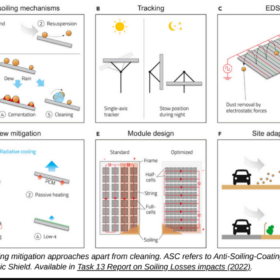
The International Energy Agency’s Photovoltaic Power Systems Programme says dust, pollution, and debris on solar panels reduce output by 4% to 7% worldwide, costing the industry billions of dollars annually and making tailored mitigation increasingly urgent.
FRV Australia’s largest solar farm reaches full operations
The 300 MW Walla Walla Solar Farm in southern New South Wales has commenced commercial operations according to developer Fotowatio Renewable Ventures.
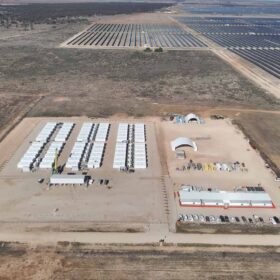
Australia’s first eight-hour battery registered with AEMO
Australia’s energy transition has reached a new milestone with the nation’s first eight-hour duration battery energy storage system now registered and eligible to begin commissioning and testing ahead of commercial operation.
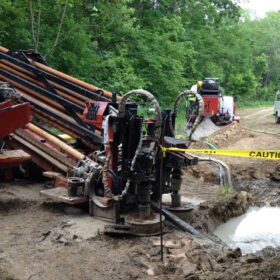
Intium deploys advanced technology for Mulwala solar farm grid connection
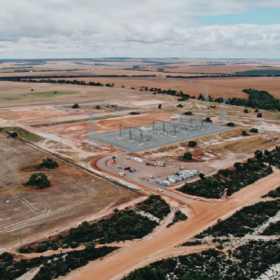
Australian high voltage infrastructure company Intium is deploying advanced technology to connect European Energy Australia’s 32 MW Mulwala Solar Farm to the grid.
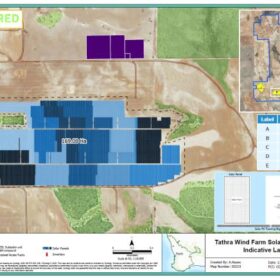
WA gentailer plans 2 GW wind, solar and battery hub
Western Australian government-owned utility Synergy has submitted plans to build a 2 GW hybrid renewable energy hub including up to 500 MW of solar and 500 MW of battery energy storage capacity alongside what would be the biggest wind farm in the state.
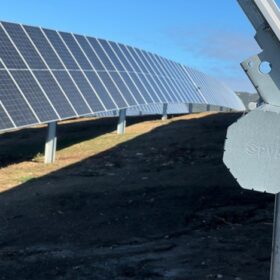
PVH secures tracker supply contract for Fulham solar project
Spanish company PV Hardware has been tapped to supply locally manufactured solar trackers for the 80 MW Fulham Solar Farm being developed by Octopus Australia in southeast Victoria.
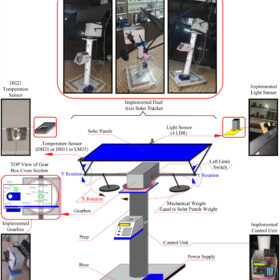
New algorithms boost dual-axis solar tracker performance
Researchers in Australia and India have developed two solar tracker optimisation techniques that can purportedly increase power generation by up to 54.36% when combined. One uses a light sensor and the other relies on data from GPS and a real-time clock.