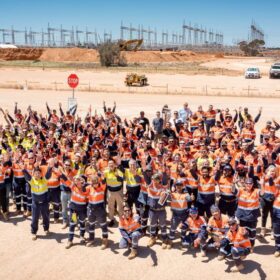
EnergyConnect transmission project records 10 million worker hours
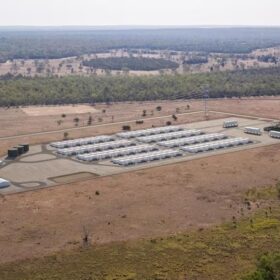
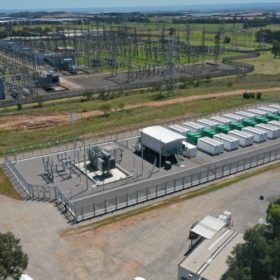
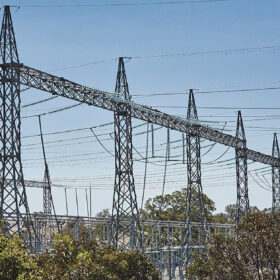
Transgrid and Elecnor Australia, construction partners on the $4.1 billion, 700 kilometre EnergyConnect transmission project have clocked more than 10 million worker hours on the epic project involving the construction of over 1,000 transmission towers.
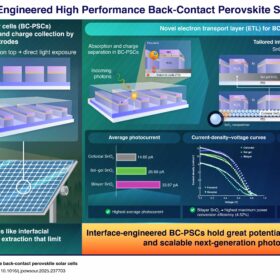
Back contact perovskite solar cell efficiency improved with breakthrough research
South Korean researchers have developed a novel bilayer tin oxide electron transport layer for improving efficiency and stability of back-contact solar cells.
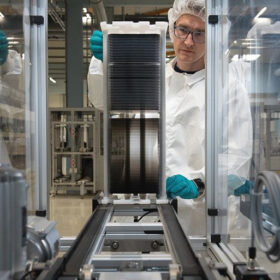
The impact of transparent conductive electrodes on perovskite-silicon tandem solar cell performance
An Oxford researcher has found that transparent conducting electrodes can reduce perovskite–silicon tandem solar cell efficiency by over 2%, with losses linked to electrical resistance, optical effects, and geometric trade-offs. Using a unified optical–electrical model, the scientist showed how careful optimisation of TCE stacks, coatings, and cell design is critical to closing the gap toward the 37%–38% efficiency frontier.
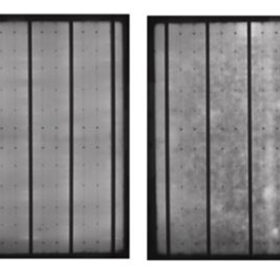
Research reveals impact of laser-assisted firing on TOPCon solar cell performance
A group of researchers from the University of New South Wales and Chinese module manufacturer Jolywood has conducted a comprehensive assessment of how laser-assisted firing processes influence the behaviour of TOPCon cells under the thermal conditions encountered during soldering, lamination, and high-temperature stress.
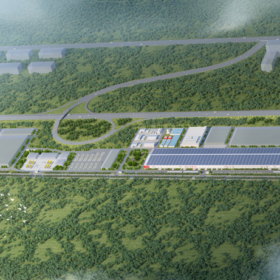
SEG Solar starts building 3 GW solar ingot, wafer factory in Indonesia
United States-headquartered SEG Solar is constructing a 3 GW ingot and wafer factory in Indonesia. The new production facility is located at its existing cell manufacturing plant, completing an end-to-end solar manufacturing chain for the company.
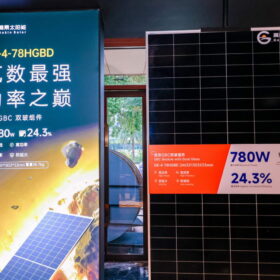
Gokin Solar launches new back-contact solar module series
Gokin has launched back-contact solar modules ranging from 480 W to 780 W for residential, commercial, industrial, and utility-scale projects. The series supports 1,500 V systems and reaches efficiencies of up to 24.8%.
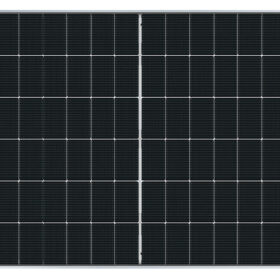
Astronergy launches 750 W anti-dust TOPCon solar module
The Chinese manufacturer said its new Astro 7 TOPCon module features an innovative self-cleaning frame and a power conversion efficiency of 23.2%.
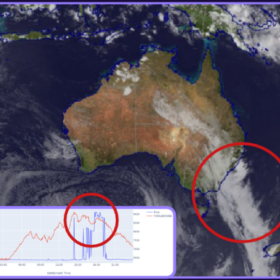
Bad weather forecasts cost Australian solar energy sector $100 million: report
Solar energy forecasting company Solstice AI research has found a 10% improvement in weather / solar forecasting accuracy would generate an extra $38 million per year in profit for Australia’s utility solar, and worldwide, $9.5 billion.
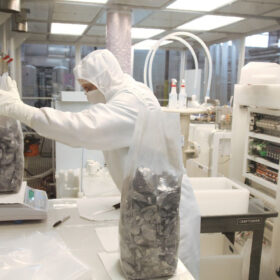
Beijing group creates official entity to guide China’s polysilicon capacity
Industry analysts say a new Beijing-based coordination platform created by China’s top polysilicon producers signals a turn toward managed capacity, as the sector tries to halt a steep price slide and mounting consolidation pressures.

Indonesian 50 MW thin-film solar factory pilot aims for 1 GW per year
Pertamina Power has teamed up with HyET Solaris to validate the commercial feasibility of producing and marketing HyET’s lightweight and flexible solar products in Indonesia, by developing a 50 MW per year factory pilot.