Horizon puts battery technologies to test at regional WA microgrids
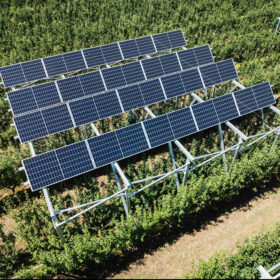
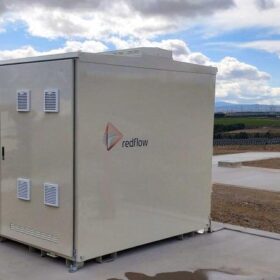
Western Australian regional energy provider Horizon Power will trial two novel long-duration energy storage technologies – including a zinc-bromine flow battery provided by Queensland manufacturer Redflow – as it seeks to identify new energy storage solutions for off-grid communities dealing with high levels of solar and extreme weather.
Electric excavator edging diesel alternative at Fortescue mine site
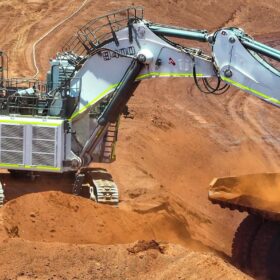
Mining and energy major Fortescue says the performance of an electric excavator operating at its Cloudbreak mine site in Western Australia’s is continuing to improve but is at times already performing better than its diesel equivalent.
Researchers reveal path to fast-charging lithium-sulphur batteries
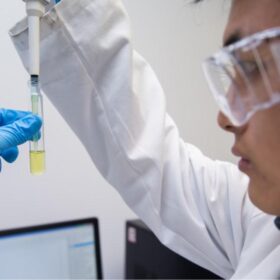
A team of Australian researchers has designed a new catalyst that has the potential to deliver a new generation of lithium-sulfur batteries that are capable of being charged in less than five minutes, instead of several hours as is currently the case.
Evaluating profitability of vanadium flow batteries
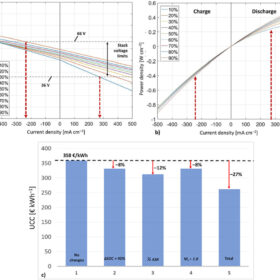
Researchers in Italy have estimated the profitability of future vanadium redox flow batteries based on real device and market parameters and found that market evolutions are heading to much more competitive systems, with capital costs down to $430/kWh at a storage duration of 10 hours.
CSIRO achieves record efficiency for roll-to-roll perovskite photovoltaic cells
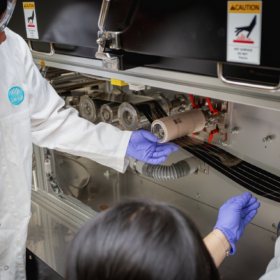
The new efficiency record for fully roll-to-roll printed perovskite solar cells set by an international team of scientists from Australia’s national science agency, CSIRO unlocks new manufacturing potential. These lightweight and flexible solar cells manufactured on very long, continuous rolls of plastic can dramatically increase the rate of production and scope for deployment.

CSIRO takes solar cell research into space
Printed flexible solar cell technology developed by Australia’s national science agency has been successfully launched into space as part of billionaire Elon Musk’s Space X’s Transporter-10 mission.
Solar waste tipped to provide material supply security
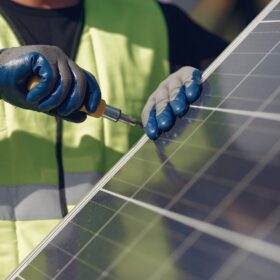
Researchers from the University of New South Wales have rejected suggestions that end-of-life solar panels will create a “waste mountain” in Australia, saying instead that they could serve as valuable material reservoirs for future production.
Commissioning process spoils improvements in solar project timelines
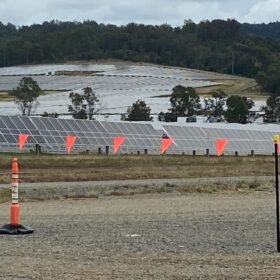
Australia’s energy transition risks falling behind with a new report showing that the time required to plan, build and commission a large-scale solar farm is almost four years with the final stage of the process having blown out to six months or more.

New anti-reflective coating for silicon solar cells
Developed by an international research group, the novel anti-reflective coating is based on silicon dioxide and zirconium dioxide. It reportedly minimises a solar cell’s reflection loss, while enhancing its light absorption properties.
Pacific delivers first hydrogen stand-alone power system for NT
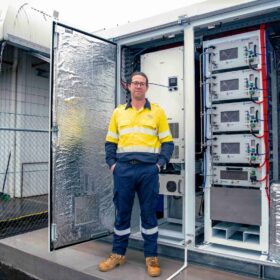
Renewables company Pacific Energy has deployed a first-of-a-kind containerised hydrogen electrolyser and fuel cell as part of a technology development project that is exploring the feasibility of using hydrogen as a clean energy source and storage solution for the Northern Territory’s grids.