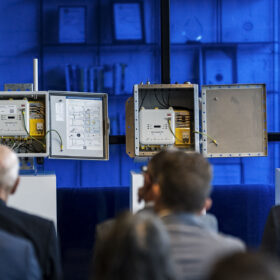
IND targets global rollout of grid fault detection technology
IND Technology, the electricity grid safety start-up that was spun out of RMIT, has raised $50 million to help accelerate the global rollout of the company’s early fault detection technology.

Incat powers up world’s largest battery-electric ship
Australian shipbuilder Incat Tasmania has powered up the world’s largest battery-electric ship – and the largest electric vehicle of any type on the planet – and successfully completed its first e-motor trial in Hobart.
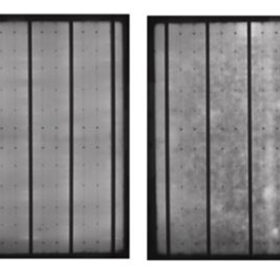
Research reveals impact of laser-assisted firing on TOPCon solar cell performance
A group of researchers from the University of New South Wales and Chinese module manufacturer Jolywood has conducted a comprehensive assessment of how laser-assisted firing processes influence the behaviour of TOPCon cells under the thermal conditions encountered during soldering, lamination, and high-temperature stress.
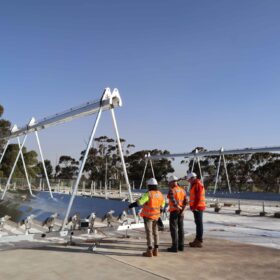
Sparc achieves production milestone at hydrogen pilot plant
Fortescue-backed startup Sparc Hydrogen has begun producing green hydrogen directly from water using concentrated solar at what it describes as a “first-of-its-kind” pilot plant in South Australia.
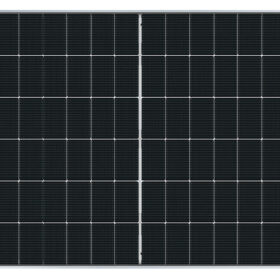
Astronergy launches 750 W anti-dust TOPCon solar module
The Chinese manufacturer said its new Astro 7 TOPCon module features an innovative self-cleaning frame and a power conversion efficiency of 23.2%.
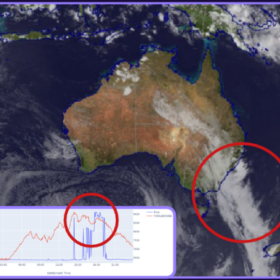
Bad weather forecasts cost Australian solar energy sector $100 million: report
Solar energy forecasting company Solstice AI research has found a 10% improvement in weather / solar forecasting accuracy would generate an extra $38 million per year in profit for Australia’s utility solar, and worldwide, $9.5 billion.

Indonesian 50 MW thin-film solar factory pilot aims for 1 GW per year
Pertamina Power has teamed up with HyET Solaris to validate the commercial feasibility of producing and marketing HyET’s lightweight and flexible solar products in Indonesia, by developing a 50 MW per year factory pilot.
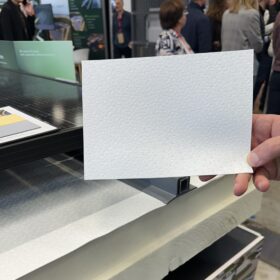
Renolit showcases reflecting cool roof membrane for bifacial rooftop PV
Renolit France has introduced the Alkor Bright reflective membrane for bifacial rooftop PV systems, offering high solar reflectivity and durability for flat or pitched roofs. The membrane helps keep buildings cooler while boosting the energy output of bifacial solar modules.
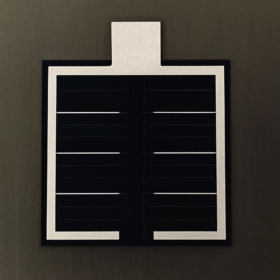
Perovskite-silicon tandem solar cell with steric complementary design achieves 32.3% efficiency
Researchers in China developed a monolithic perovskite-silicon tandem solar cell using a steric-complementary interface design, achieving a certified efficiency of 32.12% and enhanced long-term stability. This strategy optimises molecular fit in the perovskite lattice, improving both charge transport and device longevity.
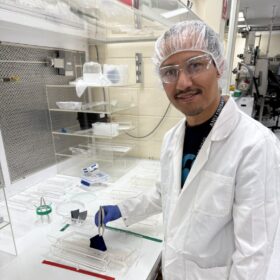
ANU teams with Longi to explore doping options in solar wafer manufacturing
An international research team led by the Australian National University and Chinese module manufacturer Longi has investigated antimony-doped Czochralski-grown silicon ingots as an alternative to phosphorous-doped ingots in the manufacturing of PV wafers and has found they exhibit slightly higher mechanical strength.