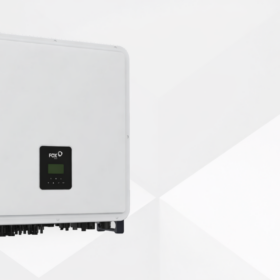
Fox ESS releases hybrid inverters for commercial PV
The inverters offer up to 99.2% efficiency, 200% PV oversizing, dual battery inputs, IP65 protection, and support for installations up to 144 kWh of storage capacity.
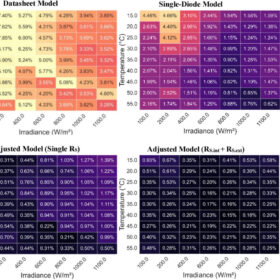
New single-diode model tackles recombination losses in solar cells
UNSW researchers have developed an intrinsic-adjusted single-diode model that explicitly accounts for radiative and Auger recombination, improving I–V curve accuracy and reducing root mean square error by up to a factor of three. The model is claimed to better predict performance near open-circuit voltage and maximum power point.
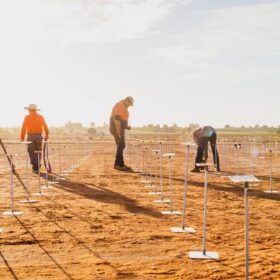
ASE plans PEG mounting system for 400 MW solar farm
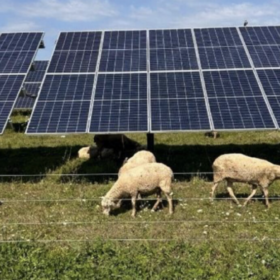
Australian Solar Enterprises has submitted plans for a new large-scale solar and battery project in Queensland for federal environmental approval, saying the 400 MW solar farm will utilise a ground-mounted racking system that eliminates the need for concrete foundations and permanent footings.
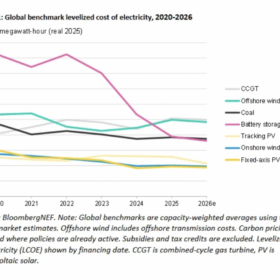
Solar LCOE to fall 30% by 2035, says BloombergNEF
Analysis from BloombergNEF finds the levelised cost of electricity (LCOE) of a typical fixed-axis solar farm increased by 6% year-on-year in 2025 to stand at $55/MWh, but innovation and competition are expected to see costs fall by 30% through to 2035.
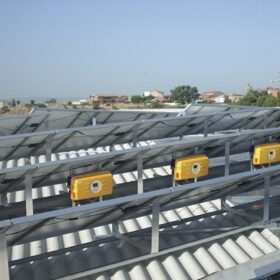
New method offers low-cost solution for improving PV system performance
An Australian research team has developed a five-step, rule-based method that detects and classifies underperformance in PV systems using only AC-side inverter data. Validated across more than 1,000 systems, the approach offers a low-cost, low-intervention solution for improving reliability, fault response, and PV system performance.
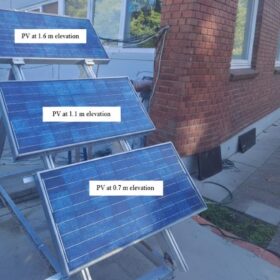
The effects of solar module elevation on ground-mounted solar
Scientists in Hungary found that ground-mounted solar modules at an intermediate elevation of 1.1 metres achieve the highest efficiency and power output due to improved airflow and reduced cell temperature.
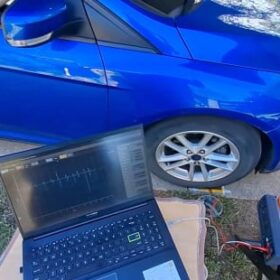
Researchers harvest energy using piezo-active nylon
RMIT University researchers have opened the door of possibility for self-powered sensors on roads and other electronic devices by generating piezoelectricity using a flexible nylon-film device.

Global-warming-induced degradation could raise rooftop solar LCOE by up to 20%
A global study finds climate change will sharply increase high-temperature risks, accelerate degradation, and raise costs for rooftop PV, with economically disadvantaged regions hit hardest. Researchers warn current IEC standards underestimate future risks, urging urgent updates to avoid stranded assets and rising electricity costs.
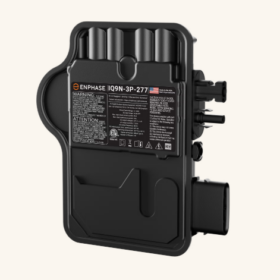
Enphase releases new control software for its IQ8, IQ9 microinverters
The United States company said its Power Control software is designed to help installers reduce costs and streamline interconnection. Among its features is the ability to control aggregate system exports through software-based limits.
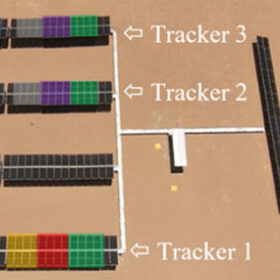
New algorithm reduces solar module temperature during clipping, curtailment
UNSW researchers have developed a thermal-aware tracking algorithm that reduces solar module temperatures and UV exposure during inverter clipping and curtailment, slowing degradation without lowering AC output. Tested in Chile’s Atacama Desert, the strategy was found to lower module temperatures by up to 7.7 C.