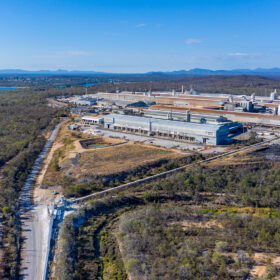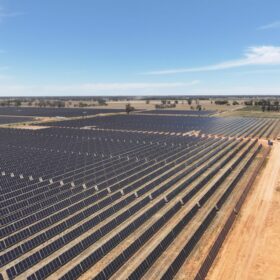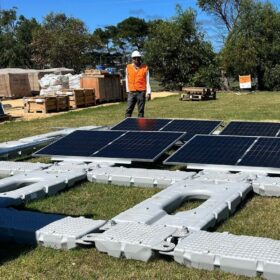
Enerflow plans 1.2 GWh vanadium flow battery project for Australia
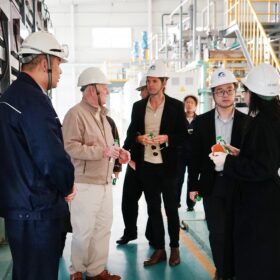
China’s Enerflow will partner with Perth-based firm Jenmi Investments to jointly develop a 350 MW / 1,200 MWh long-duration storage project, marking a major step for vanadium flow battery technology in the Australian grid.
Perovskite-silicon tandem solar cell with steric complementary design achieves 32.3% efficiency
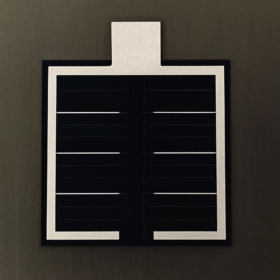
Researchers in China developed a monolithic perovskite-silicon tandem solar cell using a steric-complementary interface design, achieving a certified efficiency of 32.12% and enhanced long-term stability. This strategy optimises molecular fit in the perovskite lattice, improving both charge transport and device longevity.
Renewables on rise as AEMO lays out roadmap for energy transition
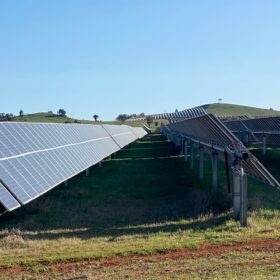
A draft blueprint for Australia’s energy market calls for 120 GW of grid-scale solar and wind, 87 GW of rooftop PV, 55 GW of dispatchable storage and 6,000 kilometres of new transmission infrastructure by 2050 to replace retiring coal plants, meet a near doubling of electricity demand, and deliver on government emissions and renewable energy targets.
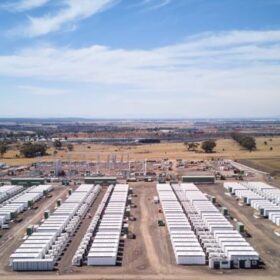
Equis launches 1.6 GWh renewable energy hub
One of Australia’s biggest battery energy storage projects has powered up with renewables developer Equis Australia confirming that the 600 MW / 1.6 GWh Melbourne Renewable Energy Hub in Victoria is now fully operational.
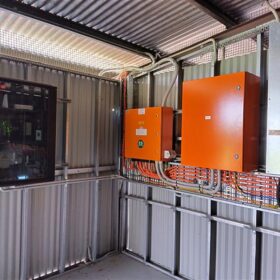
Horizon rolls out renewable energy solutions for remote communities
Offgrid power systems based on solar generation and battery storage are to be deployed in 21 of Western Australia’s most isolated communities as part of a $27 million investment by the state government.

Oversized batteries are blowing out Cheaper Home Batteries budget
The federal government’s $2.3 billion Cheaper Home Batteries Program is subsidising unnecessarily large energy storage systems and blowing out in cost.
pv magazine Awards 2025 winners revealed
Excellence was on display across all eight categories in the pv magazine Awards 2025 with plenty of innovation in both established and new market segments. From world-firsts to second-life solutions, this year’s winners brought cutting edge solutions to challenges facing solar and storage. The time has come to reveal the winners and highly commended finalists…
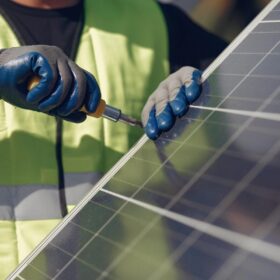
Distributed PV employment globally outpaces utility-scale solar, says IEA
The latest edition of the International Energy Agency’s (IEA) World Energy Employment report found employment in the PV sector surpassed 5 million in 2024, with distributed solar accounting for two-thirds of all solar employment globally, despite representing only 43% of installed capacity.
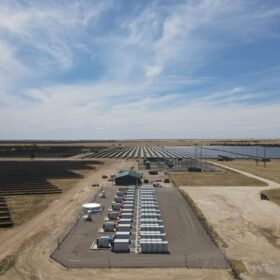
Vena building new battery as part of solar and storage precinct
Singapore-based renewables developer Vena Energy has broken ground on a 408 MWh battery energy storage system that is being built alongside an existing 182 MW of solar generation and a 41.5 MWh battery at Tailem Bend in South Australia.
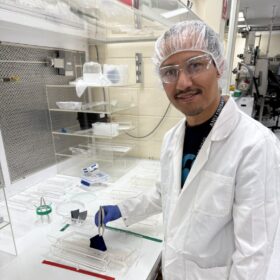
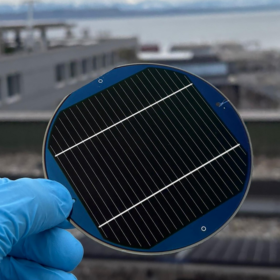
ANU teams with Longi to explore doping options in solar wafer manufacturing
An international research team led by the Australian National University and Chinese module manufacturer Longi has investigated antimony-doped Czochralski-grown silicon ingots as an alternative to phosphorous-doped ingots in the manufacturing of PV wafers and has found they exhibit slightly higher mechanical strength.