BNEF report shows drop-off in support for standalone solar
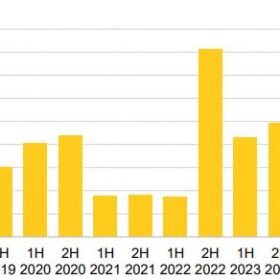
Investment in utility-scale solar in Australia dropped 35% in the second half of 2025 compared to the previous six months with Bloomberg New Energy Finance saying the growth of rooftop solar and a booming battery market are among the reasons for the precipitous decline.
$5.1 billion investment in utility-scale solar and wind forecast for 2026
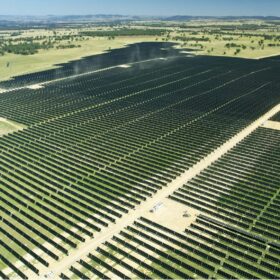
United Kingdom-headquartered energy analyst company Bloomberg New Energy Finance has forecast Australia is likely to see $5.1 billion in investment in utility scale solar and wind in 2026, though wind will account for 95% of the total.
Renewables must ramp up to 126 GW by 2030 to reach net zero by 2050, says BNEF
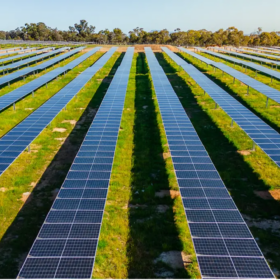
Australia can still achieve a net-zero energy transformation by 2050, in line with the Paris climate agreement, but new analysis from Bloomberg New Energy Finance shows there is no time to waste with a rapid scaling up of investment in solar, wind and energy storage required.
To be a hydrogen superpower, Australia requires 812 GW of renewables by 2050, BNEF says
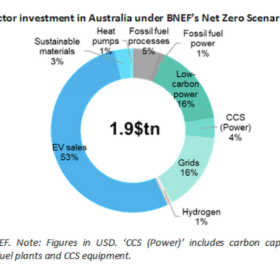
To reach net zero by 2050, Australia will need 300 GW of wind and solar, and $413 billion (USD 2.72 billion) of investment, according to BloombergNEF. To reach hydrogen superpower status, that figure balloons to 812 GW of renewables and $739 billion of investment.
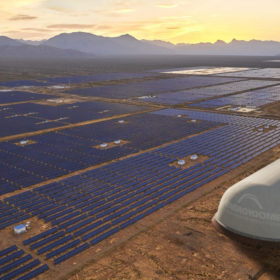
CO2 battery long-duration energy storage technology wins BNEF Pioneers 2022 competition
Energy Dome’s emission-free energy storage method uses carbon dioxide in a closed loop charge/discharge cycle that can store and dispatch renewable energy onto the grid over periods from four to 24 hours.
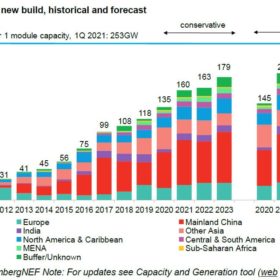
BloombergNEF expects up to 209 GW of new solar for this year
A new report from the U.S.-based analyst predicts that new PV additions for 2021 may range from 163 to 221 GW next year and from 179 to 240 GW in 2023. According to BloombergNEF, the current supply bottlenecks for glass and polysilicon will unlikely halt the global PV market.
WoodMac: Grid congestion chokes renewables investments in Australia
Wood Mackenzie analysts have expressed concern over deteriorating renewable energy investment conditions in Australia, noting that greater clarity on transmission investment is needed to support the sector.
Coronavirus could cause solar panel price spike
The coronavirus outbreak in China could raise solar module prices in the near term as manufacturers have already begun experiencing wafer and solar glass shortages. Production rates are also being affected by an extended new year holiday introduced by the authorities as a measure to deal with the virus, and the requirement workers from infected areas quarantine themselves for two weeks.
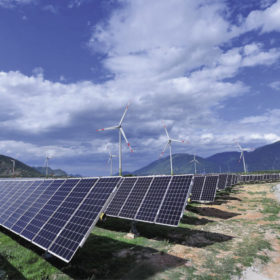
Global corporations set new record contracting 19.5 GW of wind and solar projects
Corporations contracted a record amount of wind and solar energy through power purchase agreements in 2019, up more than 40% from the previous year’s record, says a new report from BloombergNEF. The bulk of this purchasing occurred in the U.S. with tech companies and oil and gas majors leading the charge. In Australia, onsite solar projects delivering power to corporations nearly doubled to 1GW.
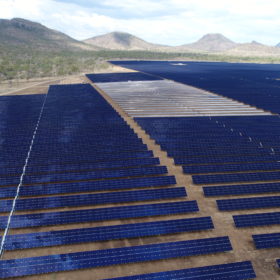
Australia poised for record large-scale PV rollout in 2020
Australia’s utility-scale renewable energy sector is set for a record year with 3.6 GW of projects expected to complete commissioning in 2020, Rystad Energy finds. This comprises 1.96 GW in utility PV projects and 1.57 GW in wind developments, with the remaining 0.1 GW coming from batteries.