Marija Maisch

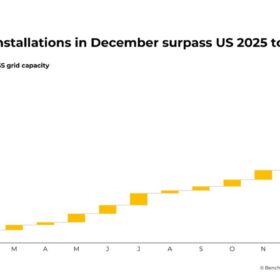
Global BESS demand jumps 51% in 2025 as installations top 300 GWh
Iola Hughes, Head of Research at Benchmark Mineral Intelligence, says 2026 is set to be another strong year for battery energy storage systems, with forecast additions exceeding 450 GWh and no material supply constraints in sight. Meanwhile, the initial impact of rising lithium prices is already visible at the cell level, but the full effect has yet to ripple through to system pricing.
Trina Storage launches AC-coupled battery for utility-scale applications
Offered primarily as a 10 MW unit, the new product is also available in a 5.5 MW version for customers with specific requirements.

Global grid-scale BESS deployment up 38% year-on-year through October
Global grid-scale battery energy storage system deployments have hit 156 GWh year-to-date. More than 153 GWh is still slated for commissioning in 2025, though delays and cancellations are likely to trim that total by year-end.
Chinese manufacturers surge ahead in Australia’s battery storage market
About 10 GWh of battery energy storage supply deals were announced at or following All Energy, further contributing to the already rapidly growing market share of Chinese manufacturers in Australia.
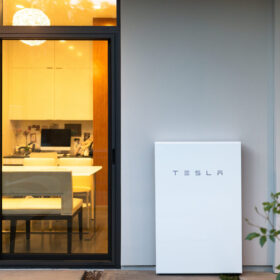
US orders recall of 10,500 Tesla Powerwall 2 battery systems
Tesla says its recall and replacement effort stems from a contained battery-cell defect that has raised safety concerns in both the United States and Australia.
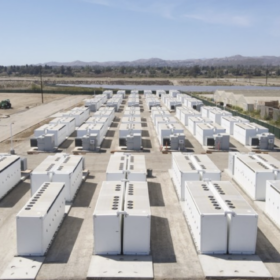
Operational faults cut returns in 19% of battery storage projects
A recent report from battery intelligence firm Accure reveals that while most battery energy storage systems operate reliably, nearly 19% of projects experience reduced returns due to technical issues and unplanned downtime.
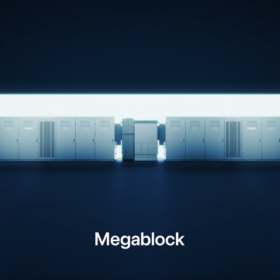
Tesla unveils new generation of utility-scale batteries
Tesla’s long-anticipated innovation in utility-scale battery storage has yielded two new products, marking a leap toward faster deployment, greater scalability, and higher energy density.
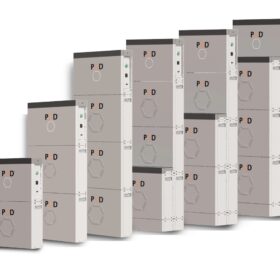
PowerCap takes its sodium-ion battery tech to Europe
After witnessing strong demand for its sodium-ion technology in Australia, Queensland company PowerCap is taking its stationary energy storage products to the European market. The initial launch will cover Italy, Germany, and Spain, with further expansion on the cards.
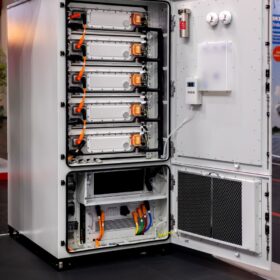
GoodWe launches 125 kW/261 kWh all-in-one C&I battery
GoodWe has introduced a 125 kW / 261 kWh all-in-one battery for commercial and industrial use in China, with applications spanning factories, farms, EV charging stations, commercial sites, and grid or off-grid systems.
‘Grid-forming technology is no longer experimental – it’s here and working’
In grids increasingly dominated by renewables, grid-forming technology is emerging as critical tool for maintaining stability and ensuring reliable power system operation. In this interview with ESS News, Rui Sun, Sungrow’s Deputy General Manager-Grid Technology Center, explains how grid-forming works, why it matters, and where the technology is already proving its value. He elaborates on technical challenges, regulatory gaps, and why grid-forming could soon become the new industry standard.