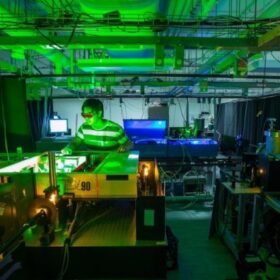
UNSW turns to AI to accelerate semiconductor materials discovery
Researchers at the University of New South Wales have developed an AI-driven system aimed at accelerating the identification of two-dimensional semiconductor materials that can be used in solar cells.
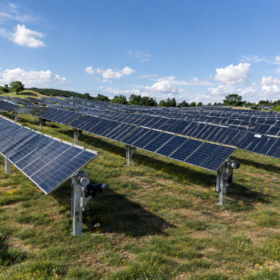
Scientists identify new loss factor in tracker-based PV plants on slightly undulating terrain
Researchers have identified a new source of underperformance in utility-scale PV plants caused by “suboptimal backtracking” on slightly uneven terrain. The study shows that real tracker control systems deviate from ideal flat-terrain assumptions, reducing irradiance capture and causing measurable energy losses compared with simulations.
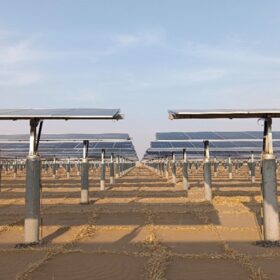
How solar farms shape local climate and vegetation in arid regions
Researchers have found that PV plants in arid regions create a measurable cool island effect that varies strongly with season, location, and plant design, influencing surrounding vegetation in complex and spatially uneven ways. They showed that cooling intensity and distance differ widely across sites, are driven mainly by plant morphology,
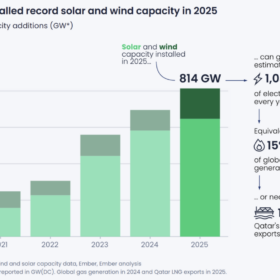
Solar leads global additions in 2025 as wind growth accelerates
A new report from global energy think tank Ember shows 814 GWdc in new solar and wind capacity was installed in 2025, but the pace of wind deployment rose 47% year-over-year compared to just 11% for solar.
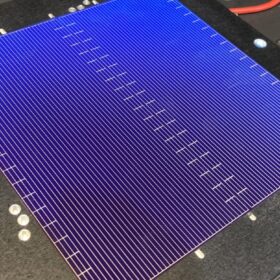
How LECO process could push TOPCon solar cell efficiency beyond 26%
A new UNSW study shows that laser-enhanced contact optimisation can boost industrial TOPCon solar cell efficiency by improving contact properties and reducing recombination losses. By combining optimised firing conditions with LECO “repair” of contacts, the approach balances recombination and resistance, offering a practical path for conventional TOPCon cells to compete with PV technologies offering higher efficiencies.
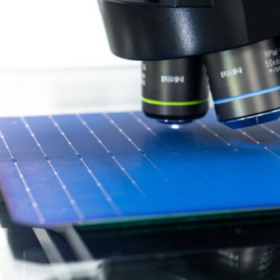
Photovoltaic research and innovation essential to ensure energy security
Researchers from 11 universities globally, including the University of New South Wales, have collaborated on a paper advocating for the need to guarantee energy security, research in photovoltaics is essential for continued innovation.
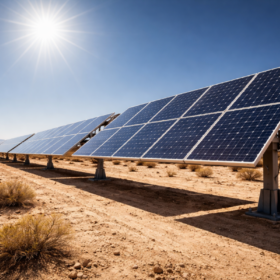
UNSW study finds tracker-based PV systems experience higher UV degradation than fixed-tilt arrays
New research from the University of New South Wales shows that PV module degradation varies widely with system design and location, driven by UV exposure, temperature, humidity, and atmospheric conditions. Tropical and desert regions face the highest stress, highlighting the need for climate-specific testing and system design.
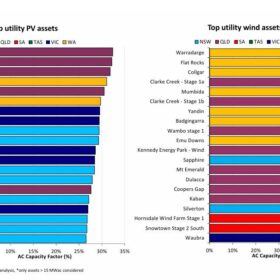
Queensland solar assets top utility PV performance table
Output from Australia’s utility-scale solar assets jumped almost 22% in the past 12 months with new data showing the country’s large-scale PV assets generated 1.82 TWh of clean energy last month.
Heterojunction vs. TOPCon in perovskite-silicon tandem
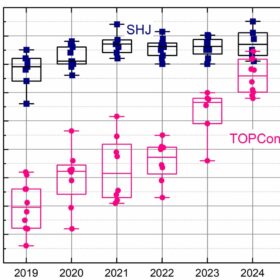
Scientists at the Australian National University claim that TOPCon cells are rapidly closing the open-circuit voltage gap with HJT counterparts, now under 10 mV, while offering greater wafer tolerance and high industrial scalability. Despite slightly lower efficiency, TOPCon-based perovskite/silicon tandems can achieve a levelised cost of energy comparable to HJT-based tandems due to reduced fabrication costs, according to the researchers.
Study shows impact of annealing on copper-plated HJT solar cells
A UNSW-led team found that annealing conditions significantly affect stress, strain, and microstructure in copper-plated heterojunction solar cell contacts, with fast annealing increasing microstrain in both copper and indium tin oxide.