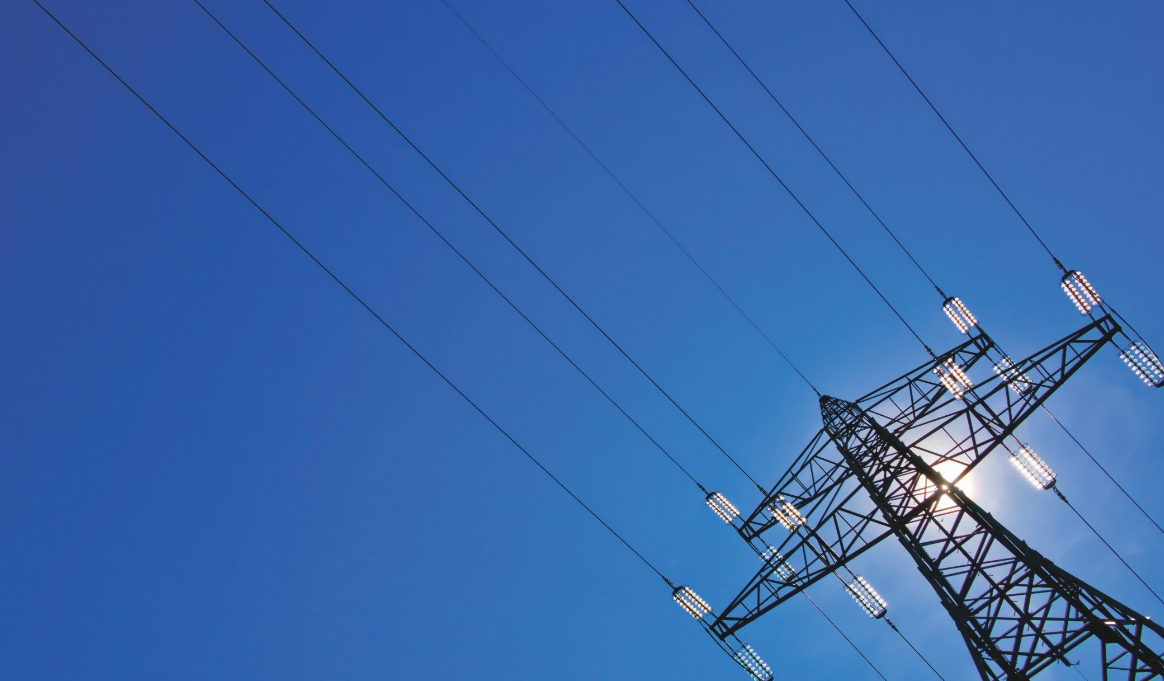





Through the Queensland government’s Energy Roadmap, announced 10 October 2025, delivery plans for the CopperString transmission project have been laid out in an effort to save the project beleagured by cost blowouts of nearly $12 billion (USD 7.8 billion), with the government allocated $2.4 billion in its 2025 budget to allocate to CopperString.
Backed by a review of the project done by the state-owned Queensland Investment Corporation (QIC), key measures have been laid out, including that QIC in partnership with the private sector, will oversee the delivery of CopperString.
The Eastern Link transmission line will revert from it’s current target of 500 kV to its original scope of 330 kV to achieve a $2.1 billion saving, the government said.
The Eastern Link from Hughenden to Townsville will now be completed by 2032, with construction on track for 2028, pending federal approvals, and early works will start soon on the $225 million Flinders Substation, located 69 kilometres southwest of Brisbane.
The Energy Roadmap also accounts for work on CopperString’s Western Link to begin with a $200 million North West Energy Fund to deliver generation and storage in the outback towns of Mount Isa, Cloncurry, Julia Creek and Richmond.
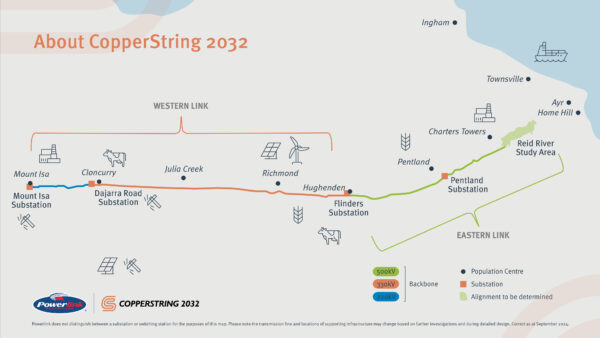
Image: Powerlink
Treasurer and Minister for Energy David Janetzki said the Crisafulli Government remained unwavering in its commitment to the project and the region.
“We said we’d save CopperString, and we have. QIC has been out in the field talking to locals and looking at what’s needed for the region and all Queeslanders,” Janetzki said.
“Hughenden will remain the heart of the project, with QIC’s review affirming our decision to commence work on the Eastern Link first to connect to the National Electricity Market sooner.”
The governent says the Energy Roadmap creates reduced energy system costs to 2035 of $26 billion, while also allocating $400 million to the QIC-managed Queensland Energy Investment Fund (QEIF) and new investor gateway to drive public sector investment in new energy generation and firming projects.
An investment of $10 million is promised for community level batteries for solar storage and to help manage minimum system load, plus the establishment of regional energy hubs “to put downward pressure on development costs”, a statement said.
A new code of conduct for renewable energy developers will be created, to guide responsible behaviour and set community expectations.
Green light for coal and gas projects
Janetzki said the former Labor government’s ideological decision to close coal units by 2035, regardless of their condition, is officially abolished.
“Queensland’s coal-fired fleet is the youngest in the country and state-owned coal generators will continue to operate for as long as they are needed in the system and supported by the market,” Janetzki said.
“We’re laying the groundwork for private capital to flow into new energy infrastructure, unlocking economic growth and ensuring Queensland remains competitive in an evolving energy market.”
The inclusion of a tender for 400 MW of new gas-fired generation in Central Queensland, and clear decision-making framework for the operation of state-owned coal assets, drew ire from the clean energy, conservation and finance sectors.
Clean Energy Investor Group (CIEG) Head of Policy and Advocacy Marilyne Crestias said the Queensland 5-Year Energy Roadmap comes with announcements that risk damaging investor confidence at a critical time.
“CEIG is disappointed the Roadmap lacks a clear plan for coal retirements and leaves the door open to further extensions. Certainty on coal closures is essential – shifting timelines only heightens investor risk and undermines project financeability,” Crestias said.
“Announcements of new government-led gas projects and tenders risk sending mixed signals to investors at a time when clear direction is needed. Prolonged reliance on gas undermines investor confidence in the state’s transition strategy and risks crowding out private capital that is ready to invest in clean energy alternatives.”
Institute for Energy Economics and Financial Analysis (IEEFA) Lead Analyst Johanna Bowyer said Queensland needs to replace its ageing, increasingly unreliable coal-fired power stations with new low emissions assets as quickly as possible to maintain a reliable power supply and cut emissions.
“Refurbishing old coal plants to keep them going for longer carries risk – as seen in the Muja AB refurbishment in Western Australia which cost triple the original budget and shut just three years after the project was finished, wasting around $300 million of taxpayers’ money,” Bowyer said.
NEXA Advisory Chief Executive Officer Stephanie Bashir said every report and analysis of the electricity market makes it crystal clear that delaying the transition is the worst possible outcome for consumers.
“Extending coal, which is already unreliable and expensive, means more outages, higher bills and less investment in cheap renewable alternatives, like wind and solar backed by batteries. The Queensland government has delivered a cul de sac, not a roadmap,” Bashir said.
This content is protected by copyright and may not be reused. If you want to cooperate with us and would like to reuse some of our content, please contact: editors@pv-magazine.com.


By submitting this form you agree to pv magazine using your data for the purposes of publishing your comment.
Your personal data will only be disclosed or otherwise transmitted to third parties for the purposes of spam filtering or if this is necessary for technical maintenance of the website. Any other transfer to third parties will not take place unless this is justified on the basis of applicable data protection regulations or if pv magazine is legally obliged to do so.
You may revoke this consent at any time with effect for the future, in which case your personal data will be deleted immediately. Otherwise, your data will be deleted if pv magazine has processed your request or the purpose of data storage is fulfilled.
Further information on data privacy can be found in our Data Protection Policy.