





Remote First Nations communities in Borroloola and Ltyentye Apurte, Northern Territory (NT) will share $11 million (USD 7.8 million) in Australian Renewable Energy Agency (ARENA) funding to develop solar and battery energy storage system (BESS) microgrids.
Respectively, the projects are located 972 kilometres (km) southeast and 1,577 km south of Darwin.
Electricity generation and distribution in Borroloola in the NT Gulf region is managed by Power and Water Corporation, which operates and maintains 3.3 MW of diesel generation capacity, and a 653 kW solar array.
Jacana Energy is currently the electricity retailer in Borroloola where most residential customers use pre-payment meters. The annual energy consumptionis approximately 6.9 GWh, with diesel generation currently providing approximately 87% of the electricity.
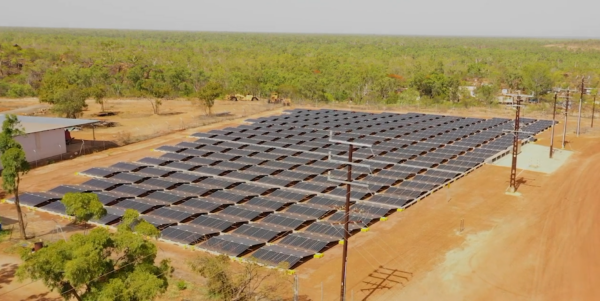
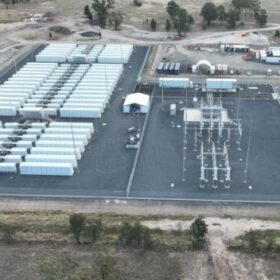
Image: Original Power
Ngardara Community Microgrid Project, Borroloola
Allocated $8.3 milion, from ARENA’s $11 million, the 2.1 MW solar and 1.8 MW / 6.6 MWh BESS Ngardara Community Microgrid Project will help the township achieve up to 80% renewable energy penetration – saving the NT government 1.2 million litres of diesel every year, offer significant electricity cost reductions to First Nations’ households, and reduce government subsidies required to mitigate volatile diesel wholesale costs.
Revenue generated by the community microgrid will also be shared with local households to provide electricity bill relief through an innovative benefit sharing arrangement pioneered by Original Power, delivering ‘solar credits’ direct to household prepayment meters.
Once operational, the project is set to transform the NT’s high-cost and diesel-reliant remote energy landscape and put First Nations’ project owners in the driver’s seat of delivering just transition pathways to lower cost, clean and resilient energy systems, Original Power said.
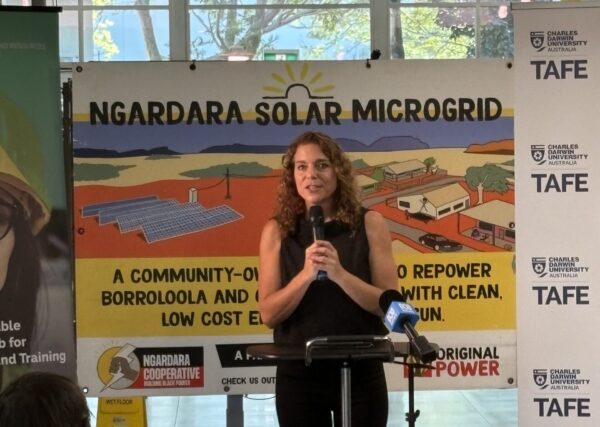
Image: ARENA
Original Power Clean Energy Projects Co-Director Madison Sturgess said the Ngardara Community Microgrid Project at Borroloola directly challenges legacy energy systems.
“[It challenges them] to innovate and evolve to the emerging reality that First Nations communities are seeking to drive renewable energy solutions that can overcome long-term challenges to energy access and affordability,” Sturgess said.
“Despite underdeveloped regulatory frameworks and traditionally monopolistic energy arrangements, the Ngardara Project has driven the Northern Territory energy sector to engage and co-deliver a viable blueprint for genuine ownership, decision making and benefit for diesel-reliant, vulnerable remote communities historically excluded from the renewables transition.”
The grant funding also helps unlock access to private and philanthropic investment, placing the project on track to achieve financial close by mid 2026 with construction commencement targeted to begin in September.
Ltyentye Apurte Microgrid
The proposed First Nations-led microgrid in Ltyentye Apurte, near Alice Springs is being developed with the Atyenhenge-Atherre Aboriginal Corporation (AAAC).
The project has the potential to improve reliability, supply renewable energy for the equivalent of around half of the community’s electricity demand and create economic opportunity for the community.
Atyenhenge Atherre Aboriginal Corporation Chief Executive Officer Ellie Kamara said the Ltyentye Apurte community prides itself on meeting the challenges of the community, on being innovative, and doing everything possible to improve the lives of the people in the community.
“One such challenge is electricity reliability; in the past few years blackouts have occurred for significant lengths of time, and there is no alternative if power is down in the community,” Kamara said.
“In the extreme hot or cold our old people suffer from either no heat or air-con, and the store cannot open – impacting food security for the community. The microgrid aims to alleviate this challenge enabling a constant source of electricity in the event of a blackout.”
The microgrid will enable selling energy back into the grid resulting in a contribution to the electricity for each household, and create the opportunity for someone from the community to upskill and help support the maintenance of the microgrid and other infrastructure around the community.
“This may appear small to an outsider, but every contribution towards a household, and each person employed in the community contributes to the overall economy and wellbeing of the community,” Kamara said.
ARENA’s Regional Microgrid Program was established in response to changes to the National Agreement on Closing the Gap, which introduced new standards for the delivery of essential services.
The Program includes $125 million in funding to develop and deploy microgrid projects in regional and remote communities, with $75 million specifically allocated to support microgrid projects in First Nations communities.
ARENA Chief Executive Officer Darren Miller said the projects reflect ARENA’s commitment to supporting First Nations participation and leadership in Australia’s clean energy transition.
“These projects show the opportunities for First Nations-led design and co-development of local energy solutions, improving reliability, lowering costs and reducing reliance on diesel,” Miller said.
“Just as importantly, they help de‑risk future community microgrid projects by generating practical learnings that other communities can draw on as they plan their own energy solutions.”
This content is protected by copyright and may not be reused. If you want to cooperate with us and would like to reuse some of our content, please contact: editors@pv-magazine.com.


By submitting this form you agree to pv magazine using your data for the purposes of publishing your comment.
Your personal data will only be disclosed or otherwise transmitted to third parties for the purposes of spam filtering or if this is necessary for technical maintenance of the website. Any other transfer to third parties will not take place unless this is justified on the basis of applicable data protection regulations or if pv magazine is legally obliged to do so.
You may revoke this consent at any time with effect for the future, in which case your personal data will be deleted immediately. Otherwise, your data will be deleted if pv magazine has processed your request or the purpose of data storage is fulfilled.
Further information on data privacy can be found in our Data Protection Policy.