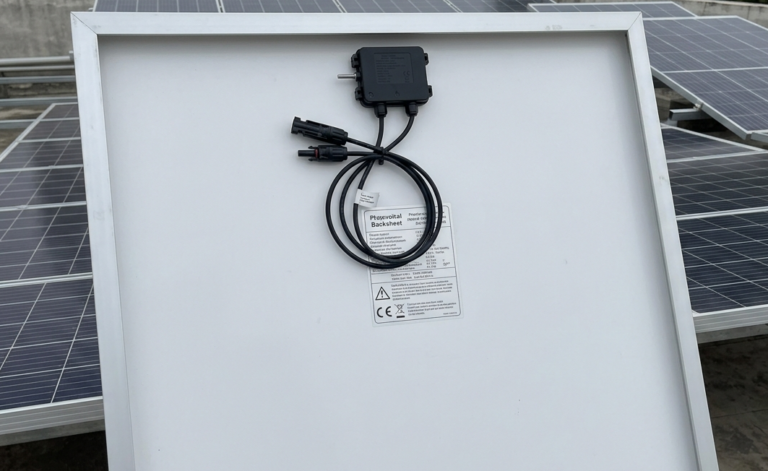





The study highlights widespread confusion between different PFAS types and emphasises the need for clearer communication and transparency around fluoropolymer use in PV technologies.
In a perspective article, researchers from Michigan State University and Oak Ridge National Laboratory examined claims about the presence and potential leaching of Per- and Polyfluoroalkyl Substances (PFAS) from solar panels.
PFAS, publicly known as “forever chemicals,” are a broad class of thousands of synthetic compounds characterised by extremely strong carbon–fluorine bonds, which make them highly persistent in the environment and resistant to natural degradation processes over time.
Because of this stability, they accumulate in ecosystems, wildlife, and sometimes human tissues, raising increasing concern about long-term environmental and health impacts.
Their chemical structure also gives them valuable industrial properties, such as resistance to heat, water, oil, and chemical corrosion, which is why they have been widely used in products like non-stick coatings, stain-resistant fabrics, firefighting foams, and certain industrial materials.
However, their persistence and widespread use have led to growing regulatory scrutiny and efforts to reduce or replace them in many applications. As a result, PFAS are now at the center of global environmental discussions balancing their technical benefits against their long-term ecological footprint.
“Our work is among the first to systematically clarify the presence and use of PFAS in solar PV modules by combining literature review with insights from discussions with PV experts,” said the corresponding author, Preeti Nain, to pv magazine.
“The article clarifies how some fluoropolymers fall in a different category of PFAS and identifies where specific fluoropolymer compounds are used within PV modules,” Nain said.
Fluoropolymers are a distinct subset of PFAS, with markedly different toxicological profiles from most other PFAS. They are large, insoluble, and generally biologically inert, meaning they do not readily break down or accumulate in the same way smaller, mobile PFAS compounds can.
As a result, fluoropolymers themselves are often considered to have low bioavailability and limited direct toxicity under normal exposure conditions.
According to the researchers, PFAS or fluoropolymers may theoretically be present in a few specific parts of solar panels. They can appear in front of glass coatings, though there is no evidence of commercial use; in the backsheets, where they might be used for weather protection; and in wires and cables, as insulation materials. Encapsulants and sealants, the scientists highlighted, typically do not contain PFAS.
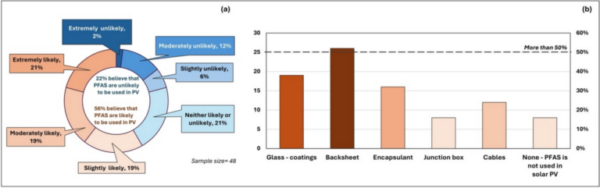
Image: Michigan State University, Perspective, CC BY 4.0
“Importantly, the work highlights that fluoropolymers are often not appropriately differentiated from more hazardous PFAS, and that mischaracterising them may lead to misleading conclusions about the environmental sustainability of PV technologies,” Nain added.
“Our comprehensive literature review on PFAS in solar panels found plenty of speculation and laboratory trials of PFAS in solar applications, but no confirmed reports of PFAS contaminants leached from real, commercially deployed solar panels.”
In addition to the literature review, the academics conducted a survey at a conference of 48 professionals, including module manufacturers, PV researchers, academic scientists, and professionals from operations and maintenance (O&M) backgrounds.
According to the responses, 59% of participants believed that PFAS use in solar PV is likely to occur. When asked about potential component-level presence, 54% selected the backsheet, and 39% chose the solar glass coatings.
“While many experts suspect PFAS involvement, there is no clear, shared understanding or publicly accessible knowledge base,” Nain said. “This reveals a significant communication gap: manufacturers may use fluoropolymers they consider low-risk, but limited transparency creates uncertainty and potential mistrust among stakeholders.”
In conclusion, the researchers said that addressing public concerns requires demanding transparency from the PV industry and supporting the use of PFAS-free alternatives.
“There is already promising movement in the right direction: manufacturers obtaining ‘PFAS-free’ certifications, policymakers incentivising PV projects on contaminated lands, and researchers providing clear, fact-based outreach on the topic,” they said.
The research was presented in “Do solar panels contain PFAS?” published in Perspective.
This content is protected by copyright and may not be reused. If you want to cooperate with us and would like to reuse some of our content, please contact: editors@pv-magazine.com.




By submitting this form you agree to pv magazine using your data for the purposes of publishing your comment.
Your personal data will only be disclosed or otherwise transmitted to third parties for the purposes of spam filtering or if this is necessary for technical maintenance of the website. Any other transfer to third parties will not take place unless this is justified on the basis of applicable data protection regulations or if pv magazine is legally obliged to do so.
You may revoke this consent at any time with effect for the future, in which case your personal data will be deleted immediately. Otherwise, your data will be deleted if pv magazine has processed your request or the purpose of data storage is fulfilled.
Further information on data privacy can be found in our Data Protection Policy.