Heavy vehicle electrification conversion centre in South Australia, a no brainer


New South Wales (NSW)-headquartered heavy vehicle electrification specialist Janus Electric has announced the launch of its first dealer-led heavy vehicle electrification conversion centre in South Australia (SA).
Enticed by the state’s high penetration of renewable energy in the grid, the company’s swappable battery model aligns with the state’s clean energy profile as the batteries can be charged during periods of high renewable generation.
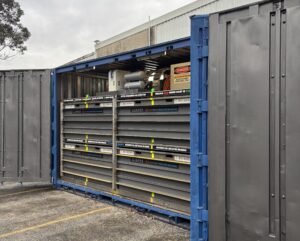
Image: Janus Electric
The company said stored energy can be deployed efficiently across freight operations and battery infrastructure can contribute to grid stability and energy balancing.
“The common perception that charging infrastructure is a constraint is often overstated,” a company anouncement said.
“Approximately 80% of Australian heavy vehicles operate less than 200 kilometres per day on repeat routes, making them well suited to depot-based charging and battery swap models.”
In high-renewable grids such as South Australia, the model allows transport demand to act as a flexible load, improving utilisation of renewable generation while supporting grid stability.
“This creates a dual benefit of significantly lowering operating costs for fleet operators (estimated 30–60% reduction in energy costs) and improving utilisation of renewable energy at a system level,” the company said.
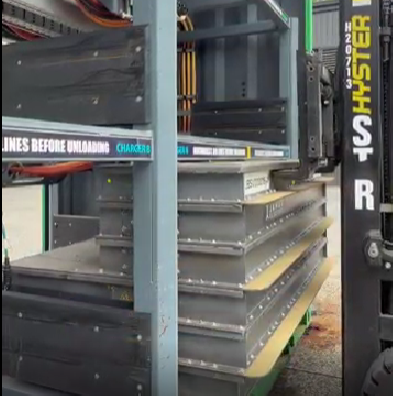
Image: Janus Electric
Batteries
Current systems use 620 kWh to 630 kWh, or two 310 kWh or 315 kWh packs, with 650 kWh, 1 MWh, and 1.4 MWh packs in development.
The batteries have a range of between 200 km to 600 km depending on the load up to 170 tonnes, are swappable in four minutes and recharge lasts approximately four hours.
Initial Janus Electric battery packs were built for approximately 5,000 cycles, the equivalent to 7 to 9 years, but with new technologies, the aim is to achieve up to 16,000 cycles.
Swap stations are designed for up to 38 MW of capacity and capable of grid-to-battery or battery-to-grid power.
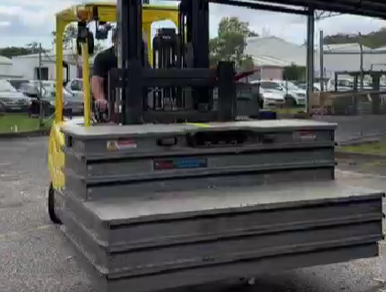
Image: Janus Electric
Expansion at scale
To be located at SA-based company Archer Heavy Equipment, 14.5 km north of the Adelaide’s CBD, the site’s initial capacity is expected to reach approximately 50 truck conversions in the first year, with plans to scale to 150-200 conversions annually as demand builds.
To date, Janus has converted 28 trucks in Australia and the USA, have completed 3,600 battery swaps completed, has 11 charge and change stations operating, with 111 contracted conversions in the onshore pipeline.
Janus Electric Chief Executive Officer Ben Hutt said the Archer Heavy Equipment conversion centre launch is a “genuine inflection point”.
“We’re now building the infrastructure and capacity to electrify heavy transport at scale and in real operating environments,” Hutt said.
“What’s needed now is the catalyst of government support. Targeted government incentives, aligned across Federal and State levels, would accelerate uptake materially and get more electric trucks on the road, faster.”

Image: Janus Electric
Policy
Electrification as an alternative to diesel power presents a structural pathway to heavy transport that is vulnerable to diesel fuel price volatility and supply chain disruption.
The company said initiatives such as the Australian Renewable Energy Agency’s (ARENA’s) Driving the Nation program, and its $25.3 million (USD 17.8 million) investment into electric truck infrastructure do signal recognition of the opportunity in heavy transport but increasingly favours networked, shared infrastructure models, reinforcing the need for coordinated, national-scale deployment rather than isolated projects.
Janus Electric is currently in discussions with partners across Victoria, Queensland and Western Australia (WA) with additional dealership agreements expected before year-end, and operates in the USA and Canada, with commercial deployments underway.
This content is protected by copyright and may not be reused. If you want to cooperate with us and would like to reuse some of our content, please contact: [email protected].

Please login to comment