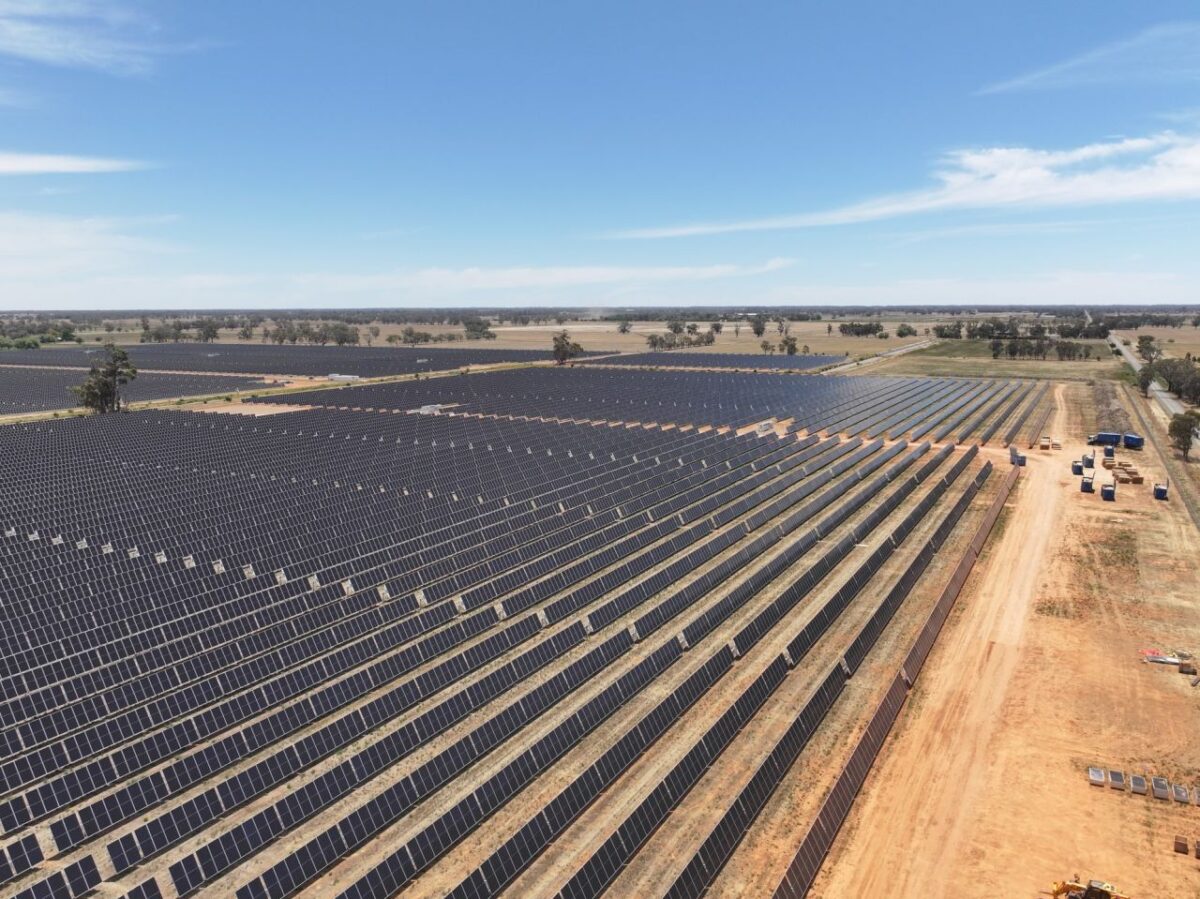





Grid-scale solar recorded an all-time quarterly high of 2,706 MW, up 648 MW year-on-year, according to new figures released by the Australian Energy Market Operator (AEMO) in its Quarterly Energy Dynamics (QED) Q1 2026 report.
Overall, renewables supplied 46.5% of generation, the highest share on record for a first quarter, peaking at 92.2% on 1 January, driven by increased solar and wind output, with the growing backbone of batteries continuing to reshape intraday patterns and suppress the need for thermal generation.
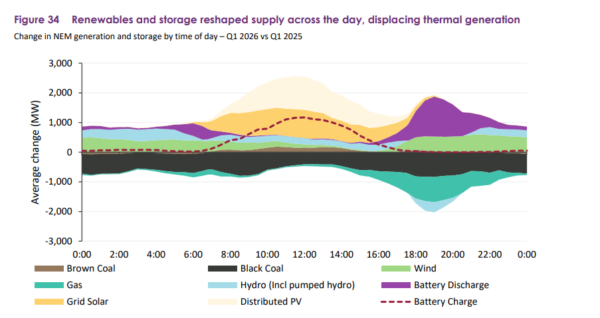
The quarter saw underlying electricity demand across the National Electricity Market (NEM) reach a record of 25,496 MW, up 1.2% on the same period in 2025, but distributed rooftop solar output offset the growth, broadly cancelling out operational demand.
Consumer Energy Resources
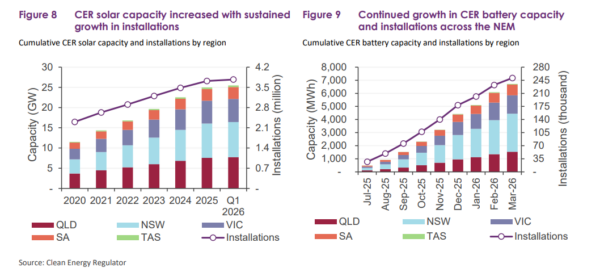
The QED reports the introduction of the Australian government’s Cheaper Home Batteries Program supported a rapid increase in
household battery uptake, with cumulative capacity reaching 6,716 MWh at the end of March 2026 and installations rising to 251,119.
By the end of Q1 2026, NSW had reached 2,911 MWh, Queensland reached 1,533 MWh, Victoria, 1,406 MWh, and SA and Tasmania reached 812 MWh and 54 MWh respectively.
AEMO Executive General Manager Policy and Corporate Affairs Violette Mouchaileh, said the quarter highlighted how energy storage and renewables are increasingly shaping electricity market outcomes.
“The significant increase in large‑scale and household battery capacity is changing how electricity is produced, consumed and priced across the day,” Mouchaileh said.
“Grid-scale batteries are increasingly absorbing excess renewable energy during the day and shifting it into the market during evening peaks, helping moderate prices during high-demand periods.”
Grid-scale solar
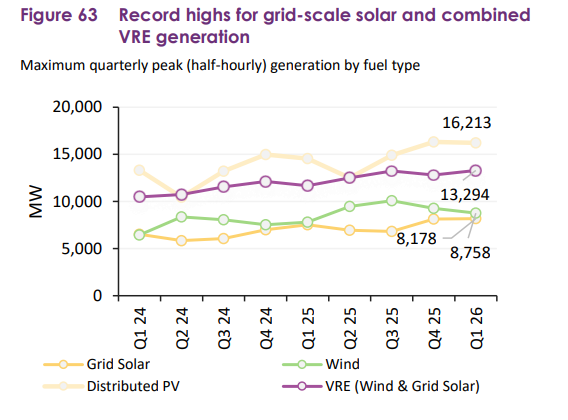
Grid-scale solar’s 13% output increase from Q1 2025, set a record rising to 2,706 MW, but on Tuesday, 6 January 2026, in the interval ending at 11.30am, grid-scale solar output topped 8,178 MW.
“This exceeded the previous peak of 8,148 MW, set in Q4 2025. Peak variable renewable energy (VRE) output, comprising wind and grid‑scale solar, also reached a new record this quarter, at 13,294 MW in the half‑hour ending at 9.30am on Friday, 9 January 2026. This was 63 MW (+0.5%) higher than the previous record set in Q3 2025,” the QED reports.
The report shows distributed solar output achieved a record 4,090 MW, up 308 MW (+8.1%) year on year, with NEM-wide operational demand averaging 21,406 MW in the quarter and distributed solar output largely offsetting that demand.
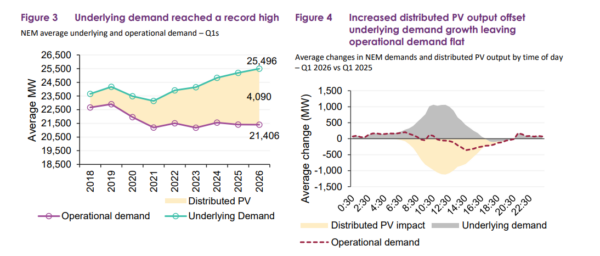
In Queensland, distributed solar output averaged 1,211 MW, up 118 MW (+11%), while in New South Wales (NSW), where underlying demand increased by up to 259 MW or 3%, to average 8,978 MW, thanks to weather conditions and data centre growth, distributed soalr output increased in Q1 by a record 1,338 MW, up 10% or 122 MW.
Victoria’s distributed solar output increased by a record 955 MW, up 48 MW (+5.3%), and in South Australia, a marginal record was set for distributed solar output, averaging 514 MW, up 11 MW, or by a 2.2% increase.
Tasmania also saw a distributed solar output record, averaging 71 MW, up 7 MW or 12%.
This content is protected by copyright and may not be reused. If you want to cooperate with us and would like to reuse some of our content, please contact: editors@pv-magazine.com.






By submitting this form you agree to pv magazine using your data for the purposes of publishing your comment.
Your personal data will only be disclosed or otherwise transmitted to third parties for the purposes of spam filtering or if this is necessary for technical maintenance of the website. Any other transfer to third parties will not take place unless this is justified on the basis of applicable data protection regulations or if pv magazine is legally obliged to do so.
You may revoke this consent at any time with effect for the future, in which case your personal data will be deleted immediately. Otherwise, your data will be deleted if pv magazine has processed your request or the purpose of data storage is fulfilled.
Further information on data privacy can be found in our Data Protection Policy.