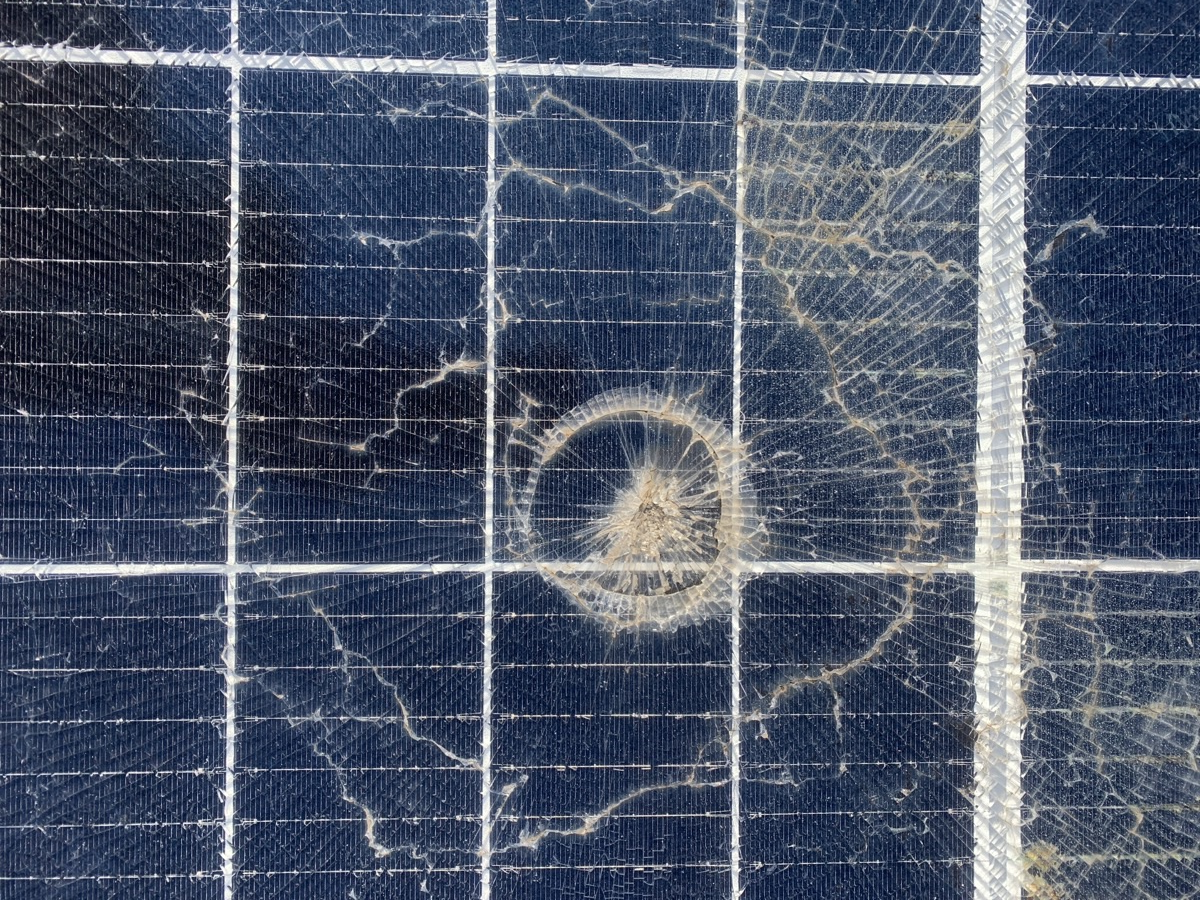





Yet for all the conversation about clean energy, remarkably little is said about what happens when those systems stop working, whether it’s the panels, inverters, or isolators, or when systems need to be entirely replaced at end of life. This is not a distant or theoretical issue. A tidal wave of end-of-life solar equipment is fast approaching, so it’s a question of when, not if, the industry is forced to deal with it.
The answer, currently, is mostly landfill. Or, in a slightly better case scenario, a pallet in a warehouse somewhere. Australia recycles only about 15-17% of solar panel materials, largely limited to aluminium frames and junction boxes. The remaining 83-85%, consisting of glass, silicon, and polymer back sheeting has nowhere meaningful to go. In most cases, the cost burden falls entirely on asset owners who must pay recyclers to take panels away, often at a significant premium to landfill, as well as cover the cost of transporting them hundreds or thousands of kilometres. It is for this reason that the recycling conversation in solar is long overdue, and the industry needs to have it honestly.
The first wave of large-scale solar installations in Australia is now approaching end-of-life. Panels installed 20–25 years ago are beginning to fail or underperform, and the volume of waste is about to accelerate sharply.
A scoping study from UNSW Sydney projects cumulative decommissioned panel volume reaching one million tonnes by 2035, with annual waste potentially hitting 100,000 tonnes by the end of the decade.
The industry has been slow to engage with what that means, and that silence carries risk. Clean energy has been built on trust that could very rapidly erode if the public perception shifts from “clean energy” to “future landfill problem.” And once it goes, it is hard to win back.
Solar panels contain genuinely valuable materials. Silver, copper, aluminium, and silicon all have real market value. In theory, recovering them makes economic sense. In practice, the economics are far more complicated.
Recycling a solar panel in Australia costs approximately $28 per panel, roughly six times the cost of sending end-of-life panels to landfill, which sits at about $4.50 per panel, before factoring in transport and logistics, which can materially increase the total cost, particularly outside metropolitan areas.
Glass is the primary problem. It makes up about 70% of a panel’s weight, but there is no high-value domestic reuse market, with silicon recovery technically possible but not yet commercially viable at scale. While silver has value, it’s only if you can aggregate enough volume to make its collection worthwhile.
The problem is, however, both volume and geography. When a regional tip recently refused to accept 370 decommissioned panels, citing insufficient capacity, the owner faced a stark choice: pay enormous fees to a recycling facility in the nearest capital city, plus significant freight charges to get the panels there. For regional and rural asset owners, the tyranny of distance turns a difficult situation into a genuinely punishing one.
For most asset owners, especially in regional areas, the decision becomes simple. Pay significantly more for a process that is logistically difficult, or dispose of the panels cheaply.
That is a system failure, not a moral one.
While much of the recycling conversation focuses on panels, inverters deserve equal attention. They have a significantly shorter lifespan, typically 10 to 12 years, meaning most systems will go through at least two inverters across the life of the installation. Yet end-of-life pathways for inverters are even less developed than those for panels.
Older transformer-based inverters can produce some scrap metal value, and newer models are processed as general e-waste, with metals and circuit board assemblies recovered at modest yields. However, there is no meaningful high-value material recovery equivalent to what is theoretically possible with panels. For most asset owners, disposing of an inverter responsibly means paying for e-waste processing and receiving nothing in return.
State governments have begun acting, but unevenly. Victoria banned solar panels from landfill in July 2019. South Australia and the ACT have imposed restrictions on e-waste disposal. Western Australia began implementing e-waste regulations in July 2024, with a landfill ban for solar panel waste anticipated in future phases.
The federal government’s proposed national pilot program, set to begin mid-2026, is also a step in the right direction. It aims to collect up to 250,000 panels across about 100 sites and generate data for a future framework.
It is a welcome start, but if the goal is to build a functioning recycling ecosystem, this will require far more than a pilot. It will require sustained government investment to expand processing capacity, increase the number of collection and drop-off points, and build out the logistics networks needed to service regional Australia.
The bigger issue is fragmentation, as state-by-state regulation is inconsistent. If other states follow Victoria’s lead on landfill bans, the resulting volume of material entering the recycling stream could help operators achieve the economies of scale that currently make the sector commercially marginal. Regulatory alignment is, in many ways, the precondition for a viable recycling industry.
Framing this purely as a recycling issue misses the broader point. The industry has historically been optimised for installation, and while that approach made sense in the early growth phase, it no longer holds up in a mature market.
The more productive conversation is about maintenance and about extending the useful life of solar system componentry before end-of-life questions even arise. Every panel that fails prematurely, every inverter replaced ahead of schedule, every fault left unaddressed until it causes broader damage represents waste the industry created before the end-of-life question even arose.
Extending asset life is not just an operational decision, but one of the most immediate levers we have to reduce volume pressure on a recycling system that is not ready.
Solar maintenance is also an environmental responsibility, as componentry in good condition is significantly easier to process when recycling capacity eventually reaches scale. Damaged panels contaminate material streams and reduce recovery yields. The condition of the system at the end of life matters, both environmentally and economically.
At the moment, there are three shifts that need to happen.
First, regulatory alignment. A national framework that standardises landfill restrictions, collection pathways, and producer responsibility is essential, and without it, scale will never materialise.
Second, economic incentives. Recycling needs to compete with landfill on cost, or landfill needs to become the less attractive option. That will likely require direct government support to improve processing efficiency, subsidise early-stage infrastructure, and reduce the cost burden currently falling on asset owners.
Third, a shift in industry mindset. Solar cannot continue to be treated as a “set and forget” asset. It needs to be managed as infrastructure with a full lifecycle, from installation through to maintenance and ultimately decommissioning.
That includes designing systems with end-of-life in mind, tracking asset condition over time, and planning for disposal long before it becomes urgent.
The solar industry is one of Australia’s great success stories, but success creates scrutiny. If we continue to avoid this conversation, others will have it for us.
The damage will not only be environmental, but also reputational. A technology positioned as part of the climate solution cannot afford to be seen as creating its own waste crisis.
The question is not whether the industry can solve this problem, because it absolutely can. The question is whether it chooses to address it early, while trust is still intact, or later, when it becomes a crisis.
That choice is being made now.
Author: Daniel Lazarus, solar O&M expert; Chief Executive Officer, Industrias
The views and opinions expressed in this article are the author’s own, and do not necessarily reflect those held by pv magazine.
This content is protected by copyright and may not be reused. If you want to cooperate with us and would like to reuse some of our content, please contact: editors@pv-magazine.com.



By submitting this form you agree to pv magazine using your data for the purposes of publishing your comment.
Your personal data will only be disclosed or otherwise transmitted to third parties for the purposes of spam filtering or if this is necessary for technical maintenance of the website. Any other transfer to third parties will not take place unless this is justified on the basis of applicable data protection regulations or if pv magazine is legally obliged to do so.
You may revoke this consent at any time with effect for the future, in which case your personal data will be deleted immediately. Otherwise, your data will be deleted if pv magazine has processed your request or the purpose of data storage is fulfilled.
Further information on data privacy can be found in our Data Protection Policy.