Solomons plan grid-scale solar project as Pacific nations push for faster transition

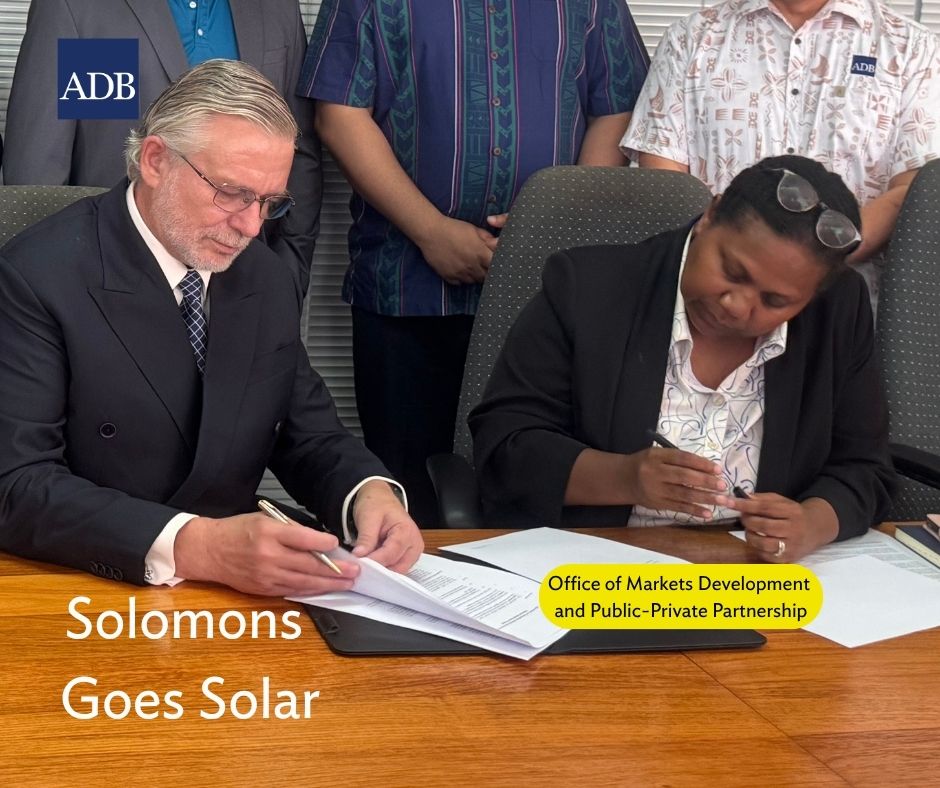
The Solomon Islands Electricity Authority (SIEA) and Asian Development Bank (ADB) have signed a transaction advisory services agreement geared towards developing the country’s first large-scale solar project.
The agreement was signed in the country’s capital, Honiara, by ADB Solomon Islands Country Director Anthony Gill and and SIEA Chief Executive Officer Delia Homelo, to support SIEA in mobilising the first solar independent power producer in the Solomon Islands to develop a grid-connected solar power project in the capital via private sector investment.
Under the terms of the agreement, ADB will act as the transaction advisor and conduct project preparation and tendering for the project via its Office of Markets Development and Public-Private Partnership. It will also support SIEA in awarding the contract to supply electricity.
As part of the technical assessments, the need for a battery energy storage system (BESS) will be reviewed.
“With tendering processes yet to commence, the selection of a private partner will be a key milestone determining the project’s timeline and the pace at which Solomon Islands can materially shift its energy mix away from fossil fuels,” an ADB Linkedin statement says.
A statement published on the government’s website explains the solar project forms part of its effort to attract investment in renewable energy generation.
Diesel currently accounts for 98% of total power generation in the Honiara grid, which the government’s statement explains exposes SIEA to fuel supply disruptions and international price volatility.
According to figures published by the International Renewable Energy Agency (IRENA), the Solomon Islands had 8 MW of cumulative solar capacity at the end of 2025, up from 6 MW at the end of 2024.
Australian Anthony Gill was appointed as the ADB’s first country director for the Solomon Islands in February 2026.
Oceania
At the 6th Pacific Regional Energy and Transport Ministers Meeting (PRETMM) underway in Port Moresby, Papua New Guinea, the Fiji government has called for an accelerated renewable energy transition and implementation of sustainable transport solutions.

Image: Fiji Ministry of Public Works
The Minister noted that Fiji continues to advance renewable energy investments, rural electrification, and transport decarbonisation initiatives, while strengthening energy security and resilience.
“Fiji’s message is clear: the policies are in place, reforms are underway, and projects are moving. What the Pacific needs now is to scale what is working — together,” Tuisawau said.
Fiji is collaborating with the Global Green Growth Institute, the United Nations Environment Programme, and the International Solar Alliance on practical initiatives including electric mobility projects, solar-powered charging systems, rural solarisation programmes, and the development of a Sustainable Maritime Transport Roadmap.
“Pacific countries may be small in size, but we continue to demonstrate leadership in climate ambition, resilience, and sustainable maritime development,” Tuisawau said.
Elsewhere in the Oceania region, the island nation of Nauru signed an agreement in early May, to develop 18 MW of solar tied to 40 MWh of battery storage.
This content is protected by copyright and may not be reused. If you want to cooperate with us and would like to reuse some of our content, please contact: [email protected].


Please login to comment