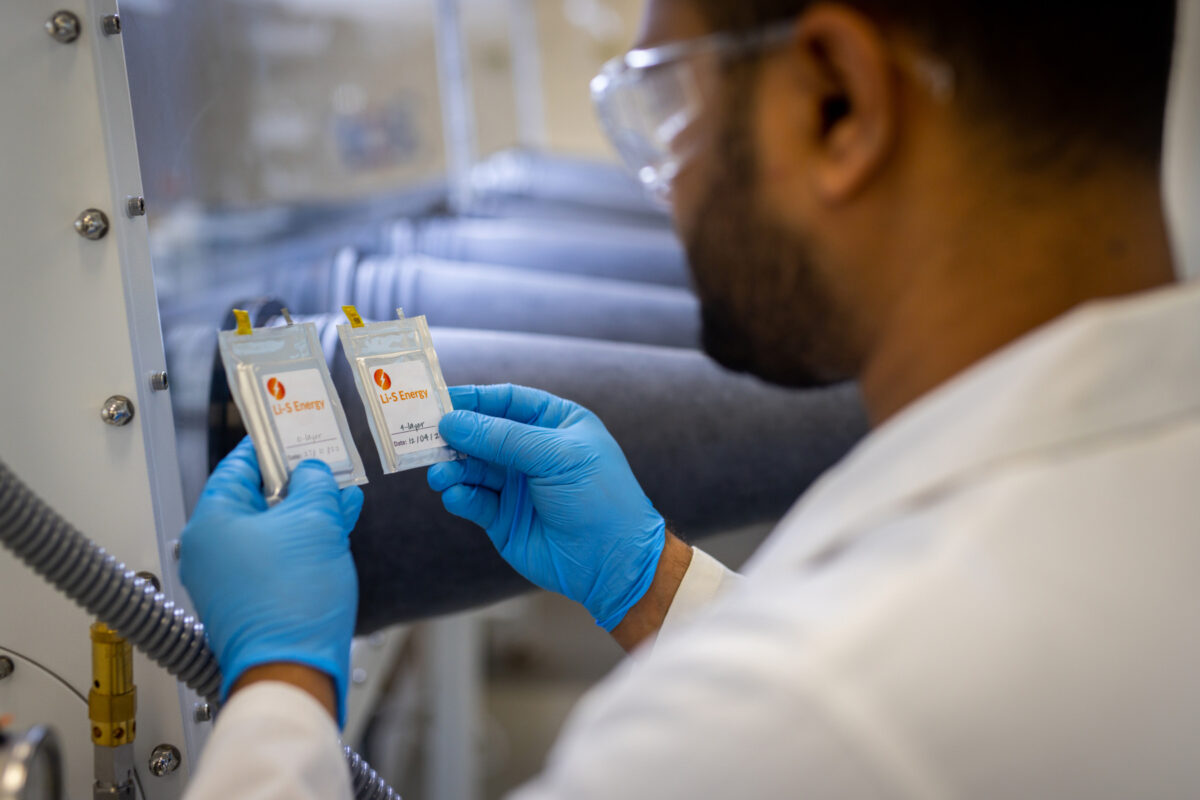





Brisbane-headquartered battery developer Li-S Energy has secured the regulatory approvals required to airfreight its prototype lithium-sulphur cells from Australia to the United States, clearing a direct supply route into the world’s largest defence and drone market.
Li-S said the “bespoke regulatory pathway” enables it to supply cells to U.S. defence, drone and government customers for evaluation and integration trials, supporting the company’s expanding commercial pipeline and supply chain positioning.
“These approvals give Li-S Energy a working pathway to deliver cells from our Geelong production line directly to US customers, primes and government agencies evaluating next-generation drone and defence platforms,” Li-S Chief Executive Officer and Managing Director, Lee Finniear, said.
“Combined with our AUKUS membership and Paladin U.S. representation, we now have the operational means to materially expand our U.S. commercial pipeline.”
Li-S is developing and commercialising next-generation lithium-sulfur and lithium-metal battery cells with its focus on the drone, defence and electric aviation markets where weight is critical.
According to Li-S, lithium-sulfur batteries have the potential to deliver up to twice the energy density of conventional lithium-ion batteries with the company having already manufactured full size 10Ah semi-solid-state cells at its production facility at Geelong in Victoria that deliver an energy density of 498 Wh/kg on first discharge and 456 Wh/kg after formation cycling, with the cells continuing to cycle in ongoing testing.
Li-S said its ultra-high energy density chemistry currently falls outside conventional lithium-ion transport classifications while remaining in prototype form.
The new approvals, issued by the Australian Civil Aviation Safety Authority (CASA) for outbound shipments from Australia and by the U.S. Pipeline and Hazardous Materials Safety Administration (PHMSA), working alongside the Federal Aviation Administration (FAA), position Li-S to engage U.S. defence prime contractors, drone manufacturers and government agencies on an end-to-end basis, from cell evaluation through to pilot supply.
“These approvals reflect the maturity of our cell design and the controls around our innovative chemistry,” Li-S Chief Technology Officer Steve Rowlands said.
“We can now place working cells with U.S. defence and drone integrators designing the next generation of unmanned platforms, where lithium-sulfur’s energy and weight advantages translate most directly into advanced capability.”
Li-S said it will begin dispatching prototype cells to U.S.-based partners and customers on a project-by-project basis.
This content is protected by copyright and may not be reused. If you want to cooperate with us and would like to reuse some of our content, please contact: editors@pv-magazine.com.



By submitting this form you agree to pv magazine using your data for the purposes of publishing your comment.
Your personal data will only be disclosed or otherwise transmitted to third parties for the purposes of spam filtering or if this is necessary for technical maintenance of the website. Any other transfer to third parties will not take place unless this is justified on the basis of applicable data protection regulations or if pv magazine is legally obliged to do so.
You may revoke this consent at any time with effect for the future, in which case your personal data will be deleted immediately. Otherwise, your data will be deleted if pv magazine has processed your request or the purpose of data storage is fulfilled.
Further information on data privacy can be found in our Data Protection Policy.