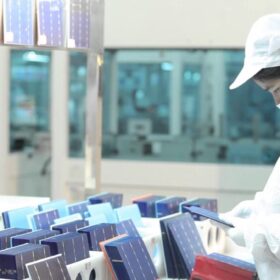
JinkoSolar claims 33.84% efficiency for perovskite-silicon tandem solar cell
Independent testing of JinkoSolar’s N-type TOPCon-based perovskite tandem solar cell has achieved a conversion efficiency of 33.84%, surpassing the company’s previous record of 33.24%,
Year in review: Solar and storage trends in 2024
In five key trends, pv magazine looks back over a year that saw PV module prices fall lower than many thought possible, while demand was restrained by grid congestion, among other challenges. Energy storage has had a strong year and geopolitics is seeing solar and battery manufacturing enter new regions as competition drives technical innovation.

JXTC looks to serve up increased cell efficiency
The solar industry has dragged its heels on the issue of silver-dependence for cell metallisation, but China’s Jiangsu Xianghuan Technology (JXTC) is moving into commercial production with a copper plating process that overcomes many of the challenges that have limited interest from cell manufacturers.
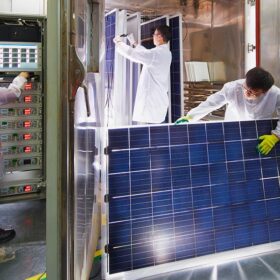
Trinasolar hits record efficiency high 27.08% for HJT solar cells
A Trinasolar efficiency record of 27.08% has been announced for large-area high efficiency n-type fully passivated HJT solar cells, certified by Germany’s leading solar energy research lab.
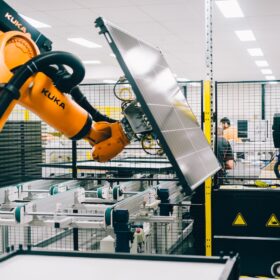
Global solar supply chain investments key to easing reliance on China: USA report
A report released by the United States Studies Centre, a joint venture of the American Australian Association and University of Sydney, encourages Australia to deeply engage in global solar supply chains, to reduce its reliance on China.
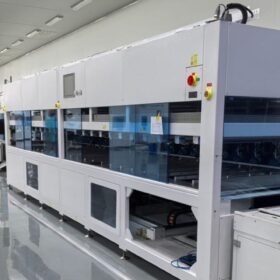
EliTe Solar opens solar cell production facility in Indonesia
Just a few months after beginning construction on a cell manufacturing factory in Egypt, Singapore’s EliTe Solar has opened a cell manufacturing facility in Indonesia, which took around eight months to complete from site selection to opening.
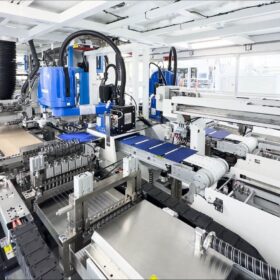
Homegrown solar sector strides forward with SunDrive’s proof of concept revealed
Australian solar module manufacturing at scale is close to reality after SunDrive achieved an above 99% copper plating production yield in the same week as signing an MoU with Capral Aluminium, driving certainty into Australia’s manufacturing capability.
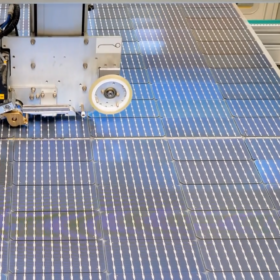
Indian solar manufacturer giant makes moves to enter Australian market
Indian module manufacturer giant Waaree Energies has incorporated a wholly owned subsidiary in Australia called Waaree Renewable Energies Australia Pty Limited, but it yet to disclose specifics.
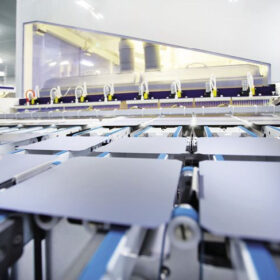
Solar manufacturing slows in bid to balance supply and demand
Smaller solar manufacturers have been shuttering production lines, but not at a pace fast enough to return profit margins to healthy territory. InfoLink’s Amy Fang considers what lies ahead for PV companies in the near term.
Quinbrook says time critical for Future Made in Australia
Renewables player Quinbrook Infrastructure Partners has lauded the newly legislated Future Made in Australia Bill as a critically important initiative that can position Australia at the core of global clean energy supply chains.