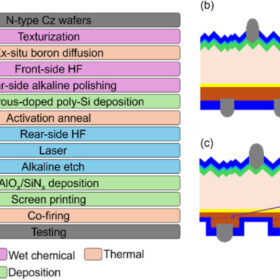
Localised polysilicon thinning improves TOPCon solar cell performance
UNSW researchers boosted TOPCon solar cell efficiency by locally thinning the rear poly-Si layer, reducing parasitic absorption while preserving wafer integrity. The champion cell built with this approach achieved 25.10% efficiency with improved bifaciality and maintained strong passivation.
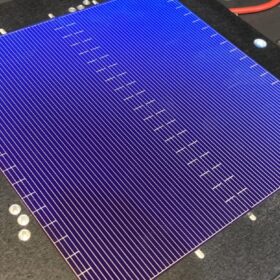
UNSW research offers guidance for more robust TOPCon solar cells
UNSW researchers developed an experimentally validated model linking UV-induced degradation in TOPCon solar cells to hydrogen transport, charge trapping, and permanent structural changes in the passivation stack. They show that thicker aluminum oxide layers significantly improve UV resilience by limiting hydrogen migration, offering clear guidance for more robust TOPCon designs.
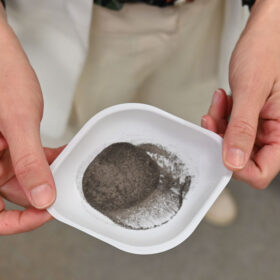
New process achieves 97% silver recovery from end-of-life solar panels
University of Newcastle researchers have developed a new separation technique that employs the same crushing and flotation principles used in mineral processing to recover more than 97% of silver from end-of-life solar panels.

Trina Solar posts new milestones for tandem efficiency, module power
Trina Solar says new certified results in perovskite-crystalline silicon tandem cells and modules demonstrate progress toward industrial-scale next-generation PV.
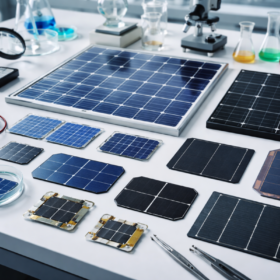
All solar cell efficiencies at a glance – delayed
The research group led by Professor Martin Green has not published yet Version 67 of the solar cell efficiency tables, due to production delays. Green, however, has agreed to comment on some of the results to be added in the upcoming edition.

Facilitating DER/CER in Australia’s two-way energy system: report
The Australian Energy Regulator has released its third annual export services network performance report on facilitating consumer energy resources in Australia’s two-way energy system.
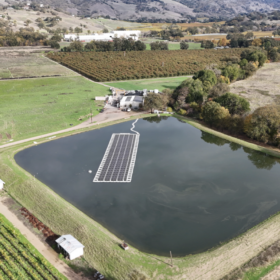
California winery runs all operations on floating and rooftop solar
A family-owned California winery has replaced grid electricity with onsite solar generation, reducing power costs and providing a live test site for floating photovoltaic research.
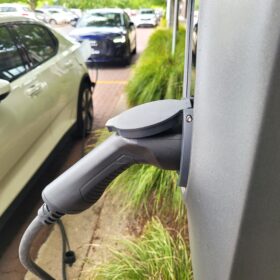
Researchers unmask fast charge potential of hard carbon anodes
Japanese researchers have found sodium-ion batteries using hard carbon anodes can intrinsically charge faster than lithium-ion batteries, challenging long-held assumptions in battery research.
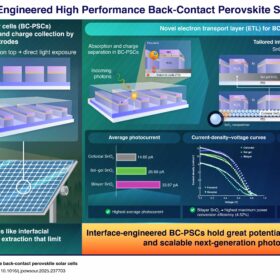
Back contact perovskite solar cell efficiency improved with breakthrough research
South Korean researchers have developed a novel bilayer tin oxide electron transport layer for improving efficiency and stability of back-contact solar cells.
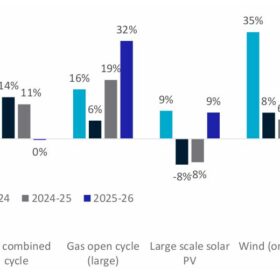
Renewables remain lowest-cost option says CSIRO report
The national science agency’s latest update on the cost of meeting Australia’s future power needs has again found firmed renewables provide the lowest-cost option for electricity generation.