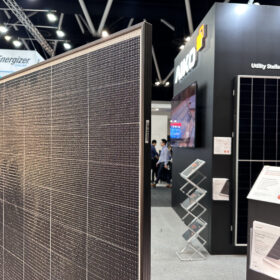
Smart Energy Expo: 8.8kg glass-free module launched by China’s Aiko
Chinese solar manufacturer Aiko has introduced an ultra-lightweight 8.8kg module to the Australian market. Aiko has swapped solar glass for high chemical plastic, affording the 450W ‘Air Series’ module its light weight.
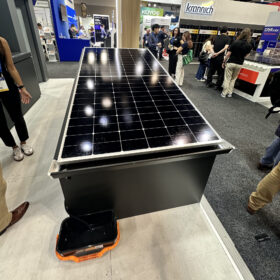
Smart Energy Expo: Longi launches anti-dust module for C&I segment
Chinese solar manufacturer Longi has launched a new ‘anti-dust’ module. The feature rests on its design where the frame sit flush with the glass on the short side, allowing water to wash off unimpeded.

CSIRO takes solar cell research into space
Printed flexible solar cell technology developed by Australia’s national science agency has been successfully launched into space as part of billionaire Elon Musk’s Space X’s Transporter-10 mission.
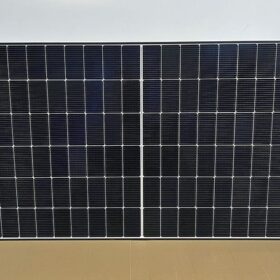
Leapton unveils 585 W TOPCon solar panel with fiberglass frame
Leapton says its new panels have a temperature coefficient of -0.30% per C and an efficiency of up to 22.65%. They come with a 30-year power output guarantee for 87.4% of the initial yield.
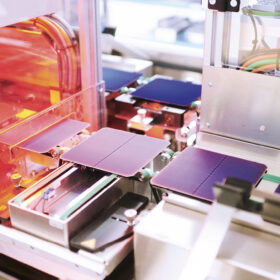
Weekend Read: Predicting the solar future
The International Technology Roadmap for Photovoltaics (ITRPV) helps to predict future solar cell and module technology trends and is influential in directing research funding and technology investment. Scientists in Australia and the United Kingdom have analyzed ITRPV predictions over the past decade, highlighting the difficulties of forecasting PV trends.
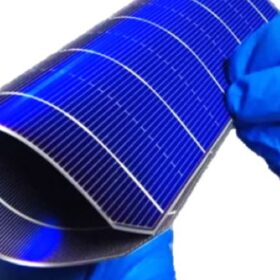
Longi develops flexible heterojunction solar cell with 26.06% efficiency
Researchers from Western Australia’s Curtin University and Chinese module manufacturer Longi were part of an international team seeking silicon material savings and efficiency gains in the development of heterojunction PV devices. The cell achieved a certified power conversion efficiency of 26.06% with a thickness of 57 μm, with Germany’s Institute for Solar Energy Research confirming the result.
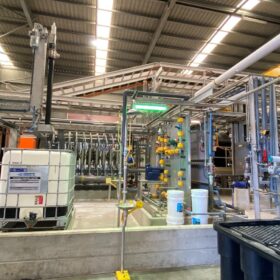
Vanadium battery players partner on Queensland manufacturing supply chain
Australian minerals company Vecco Group will team with Japanese manufacturer Sumitomo Electric and Idemitsu Australia to build an ‘end-to-end’ manufacturing supply chain for vanadium flow batteries in north Queensland.
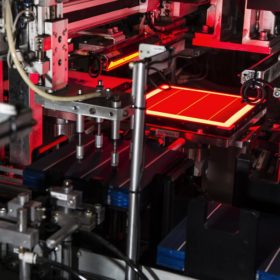
A cell maker’s survival guide
With solar production capacity expansion plans paused, bigger cell makers will weather the storm through a revised approach to new panel technologies. InfoLink’s Alan Tu says that low profits could also drive innovation and cost savings, pushing the industry to new heights.
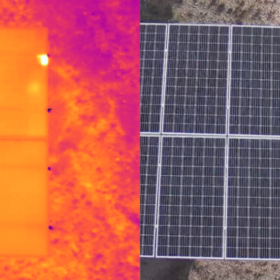
Research finds climate, degradation rethink on inverter lifespans required
New research from Belgium shows the importance of assessing inverter reliability by including climate-based PV panel degradation rates. The scientists found that, especially in hot and arid climates, PV inverters should be designed with parameters above the standard value.
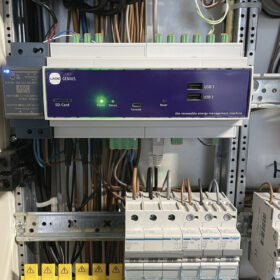
Weekend read: Artificial opportunities
Artificial intelligence (AI) is hot right now and is finding central applications in homes and businesses as they move from simple grid connections to self-generation, energy storage, electric vehicle charging, and load-shifting revenue streams. With AI everywhere, what’s the difference between advanced control via simple algorithms, and true intelligence?