Chinese scientists build 31.13%-efficient perovskite-silicon tandem solar cell via 2D seeding agent
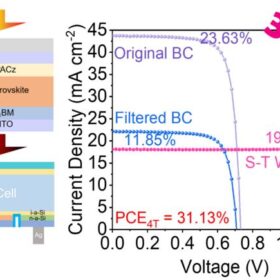
Researchers in China developed a novel two dimensional seeding agent to regulate crystallisation in a 1.80-eV wide-bandgap perovskite film. A perovskite-silicon tandem device made with the resulting optimised subcell achieved an efficiency of 31.13%, outperforming a control device.
CSIRO puts battery chemistries to test in tropical conditions
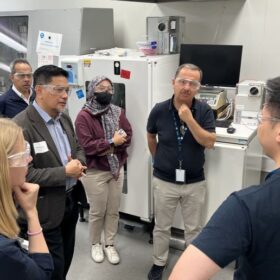
Researchers from Australia’s national science agency have teamed with Malaysian authorities to explore how different battery chemistries perform under tropical stressors like heat, humidity and corrosion, and what this means for durability, safety and cost-effectiveness.
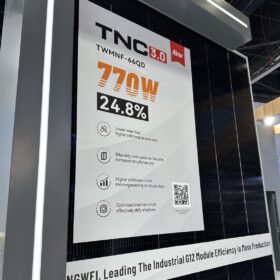
Tongwei unveils 770 W TOPCon PV module with 24.8% efficiency
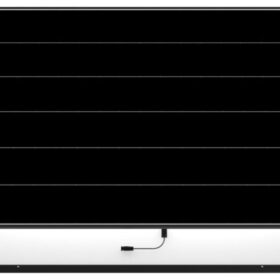
The Chinese manufacturer has unveiled its new TOPCon bifacial TNC3.0 module. The 1,500 V, IP68-rated panel offers over 85% bifaciality, a 0.26%/C temperature coefficient, and a 30-year warranty guaranteeing 88.85% output.
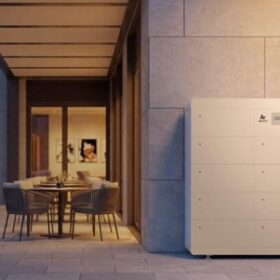
AlphaESS launches modular energy storage system for small C&I users
Designed for power ratings of 29.9 kW and 50 kW with scalable capacity up to 216,9 kWh, the new system is aimed at businesses seeking flexible energy storage solutions without the complexity of installation.
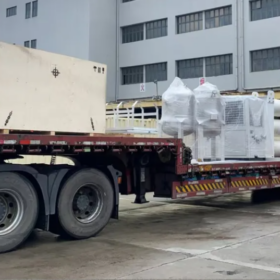
Line locks in equipment supply deal for Tasmanian green hydrogen project
Line Hydrogen has breathed new life into a 7.6 MW green hydrogen project planned for Tasmania with the signing of an equipment supply deal with Chinese manufacturer Jiangsu Guofu Hydrogen Energy Equipment Co.
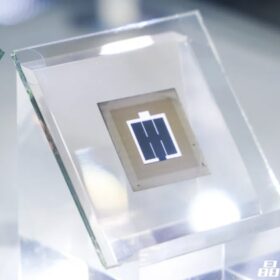
JinkoSolar pushes on perovskite-silicon tandem solar with new partnership
JinkoSolar has signed a strategic cooperation agreement with XtalPi, an “AI for Science” platform company, to pursue high-throughput R&D on perovskite-crystalline-silicon tandem solar cells using an AI platform and quantum-physics-based models.
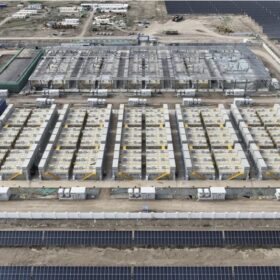
China connects world’s largest vanadium flow battery project
The GWh-scale long-duration energy storage project is expected to reduce curtailment in Xinjiang, a region of China with high solar and wind generation, and transmission bottlenecks. The flow battery installation is co-located with a PV plant.
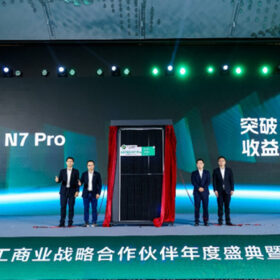
Astronergy launches 670 W TOPCon solar module with 24.9% efficiency
China’s Astronergy says its ASTRO N7 Pro module targets utility-scale PV plants and commercial rooftops, offering quarter-cell architecture, bifacial gains, and a 30-year performance guarantee.
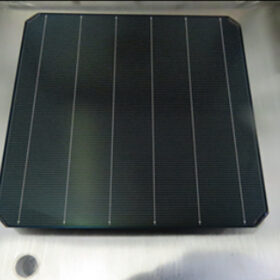
Rising silver prices drive China’s Longi shift to copper-metallised solar cells
China’s Longi says it will begin mass production of base-metal PV modules in the second quarter of 2026 as rising silver prices intensify pressure to reduce metallisation costs.
China wafer leaders lift quotes as 2026 module prices may hit $0.21/W
China’s top wafer makers raised prices on key n-type formats, signaling potential module price rises toward $0.21 (CNY 1) per watt in 2026 amid efforts to curb loss-making competition.