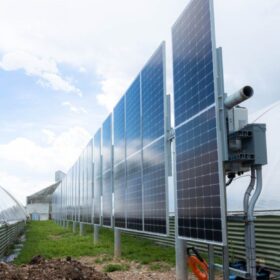
Vertical bifacial solar seeking greenhouse albedo and deployment space
A farmer in the United States has installed vertical bifacial solar, leveraging greenhouse albedo to increase output. The installation demonstrates promising generation during winter months, while maximising limited land space.
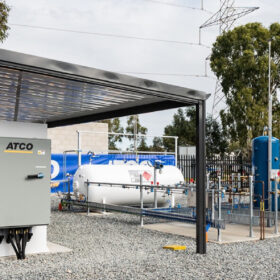
Atco shelves Western Australia green hydrogen project
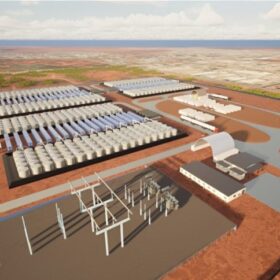
Gas major Atco has ditched its plans for a commercial-scale green hydrogen manufacturing facility proposed for Western Australia’s remote midwest, saying the distance between the production facility and end use undermined the commercial viability of the project.

To achieve net zero energy status, solar-powered buildings should not exceed 10 floors
Researchers in Canada have found that nearly zero-energy buildings (NZEBs) with on-site solar energy generation should not exceed an energy use intensity (EUI) of 50 kWh/m2a, which they said corresponds to a maximum of 10 floors. They also ascertained that the maximum permitted EUI by net-zero energy status is 17–28 kWh/m2a.
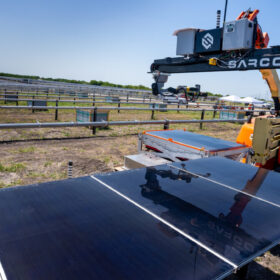
Autonomous robots for solar installation gain traction
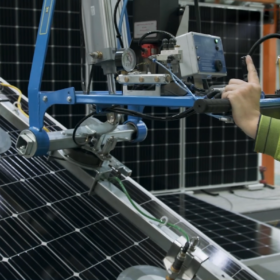
Installation robots are moving from test centres to the field. American technology companies Sarcos Technology and Robotics Corporation and Terabase Energy recently announced key business developments.
Australia invests $50 million to expand clean energy supply chains
The Australian government has committed $50 million to support the development and diversification of clean energy supply chains in the Indo-Pacific as it seeks to increase manufacturing opportunities and enhance energy security in the region.
Separator tech to prevent battery fires
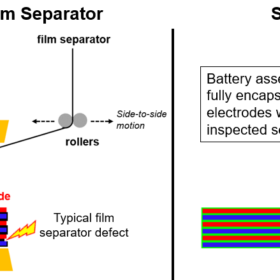
United States-based battery startup Nuvola Technology says it has developed a direct deposition polymer separator technology that can eliminate the primary cause of lithium-ion battery fires.
Fortescue snaps up ‘fast-to-market’ green hydrogen project in US
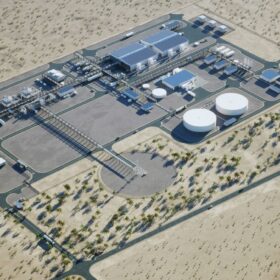
Australia’s Fortescue Future Industries has made its first major move in the United States since the passage of the landmark Inflation Reduction Act, outlaying $34.42 million (USD 24 million) to purchase the ‘fast-to-market’ Phoenix Hydrogen Hub being developed in the American state of Arizona.
Tesla sues Australia’s Cap-XX over battery technology
Tesla has filed a lawsuit in a United States federal court against Australian energy technology company Cap-XX alleging its supercapacitors infringe two U.S. patents owned by Maxwell Technologies, a subsidiary of the EV and battery manufacturing giant.
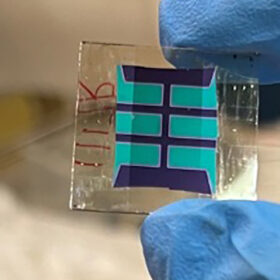
NREL develops perovskite solar cells with 93% bifaciality
A research team at the U.S. Department of Energy’s National Renewable Energy Laboratory has made highly bifacial perovskite cells with a front-side efficiency of 23%.
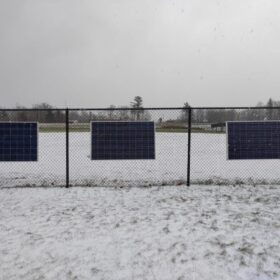
Existing fences identified as low-cost racking solution for PV deployment
Researchers are proposing to use steel zip ties to attach solar modules to fences in animal farms as a low-cost racking solution for agrivoltaic applications. They found the proposed approach is technically and economically viable, provided careful wind load tests are conducted on the fences.