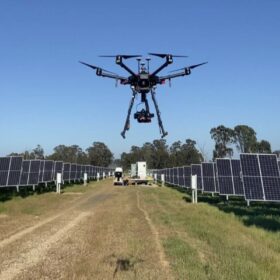
Lab360 lands funding to help get drone-based solar inspection tech off the ground
Australian photoluminescence imaging specialist Lab360 Solar will look to make the leap from lab to market with its drone-based PV inspection technology after landing $3.96 million in federal government funding.

S&P Global unveils Tier 1 module, inverter, battery supplier list
S&P Global’s first 2025 Tier 1 Cleantech Companies list ranks 63 solar, wind, inverter, and battery suppliers by technology, financial health, and sustainability to guide investors and developers.

ClearVue says next-gen solar glass delivers 66% more energy
Building-integrated PV specialist ClearVue Technology says the latest iteration of its solar vision glass delivers more than 66% additional energy output per square metre than its predecessor, while significantly reducing production complexity and costs.
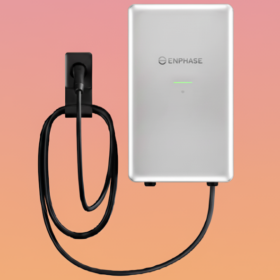
Enphase presents bidirectional EV charger
The microinverter company has disclosed details on the architecture of its IQ Bidirectional EV Charger, which will be available for sale in the second half of 2026. It is reportedly able to deliver up to 11.5 kW of bidirectional power.
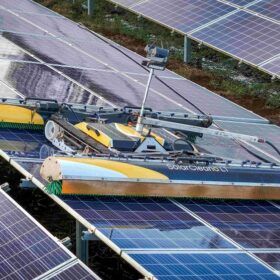
Solarcleano launches panel cleaning robot for large PV installations, trackers
The Luxembourg startup’s newest product is a portable, dry and wet cleaning system with 2.45 m wide brushes, designed to be operated by a single person.

Tesla unveils new generation of utility-scale batteries
Tesla’s long-anticipated innovation in utility-scale battery storage has yielded two new products, marking a leap toward faster deployment, greater scalability, and higher energy density.
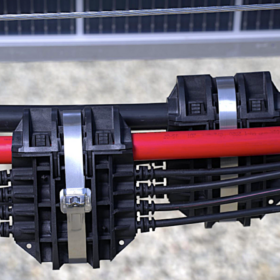
Nextracker unveils NX PowerMerge trunk eBOS for utility-scale solar
Nextracker has introduced NX PowerMerge, a 2 kV trunk connector-based eBOS solution for utility-scale solar projects, designed to cut connection points, simplify layouts, and lower project costs.
First Graphene claims major boost for perovskite solar cell efficiency
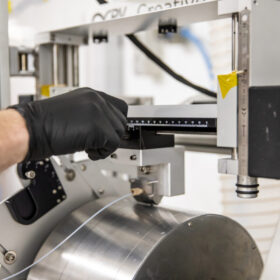
Western Australian graphene supplier First Graphene has reported the addition of its functionalised graphene product to perovskite solar cells has increased efficiency almost two-fold and reduced production costs by up to 80%.

Researchers find flames spread 46% faster on degraded module backsheets
Singapore researchers accelerated PV backsheet weathering to investigate flame spread behavior finding after six weeks, flame spread was 46% faster than on unweathered PV backsheets, saying current safety standards fail to account for long-term degradation.

$150 million round 2 Solar Sunshot targets solar supply chain technologies
The Australian Renewable Energy Agency has launched the second funding round of the $1 billion Solar Sunshot program, releasing $150 million dollars to stimulate the commercial domestic manufacture of critical segments of the solar supply chain.