Testing reveals height benefits of floating PV
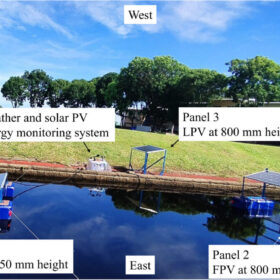
Scientists have tested the performance of floating PV panels at a height of 800 mm and 250 mm above their floating structures. Their thermal and electrical performance was compared to that of a reference land-based system and the highest panel was found to show the greatest cooling effect.
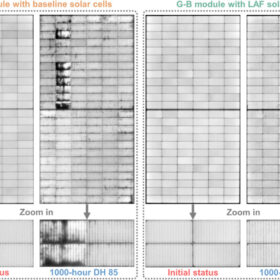
EVA-induced degradation has significant impact on power losses in TOPCon solar modules
New research from UNSW shows EVA-encapsulated TOPCon solar modules under damp-heat testing can suffer significant power losses and fill factor drops. The study describes metallisation degradation mechanisms driven by EVA-generated contaminants and demonstrates the effectiveness of metallisation adjustments in reducing EVA-induced degradation rates
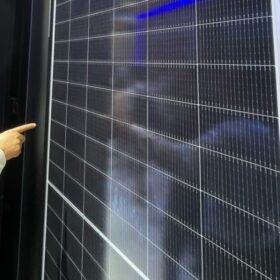
Longi achieves 34.85% efficiency for two-terminal tandem perovskite solar cell
The result was confirmed by the United States Department of Energy’s National Renewable Energy Laboratory (NREL).
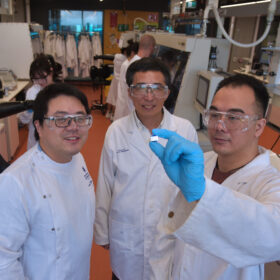
University of Queensland sets tin halide perovskite cell efficiency record
University of Queensland researchers have pushed efficiency boundaries for tin halide perovskite cells, achieving a certified record of 16.65%, one percentage point higher than the previous best.
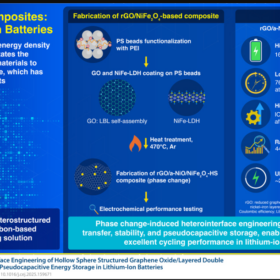
South Korean battery breakthrough using hybrid anode material
Researchers at two South Korean universities have collaborated to achieve a breakthrough in lithium-ion battery technology by developing a novel hybrid anode material.
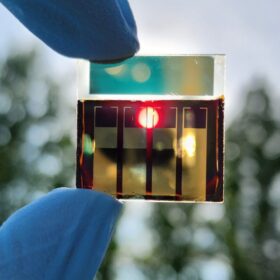
Korean researchers achieve world record efficiency of 23.64% for flexible perovskite-CIGS tandem solar cell
Scientists at the Korea Institute of Energy Research claim to have achieved the highest efficiency ever reported for a perovskite-CIGS tandem solar cell with flexible, lightweight architecture. The device was also found to achieve “excellent” durability.
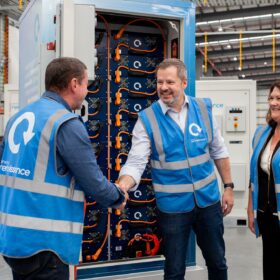
Cybersecure Australian-made residential battery launched in NSW
On the back of the federal government’s $2.3 billion home battery subsidy, a new CSIRO designed and Energy Renaissance-built residential battery has been launched at a New South Wales-based gigafactory.
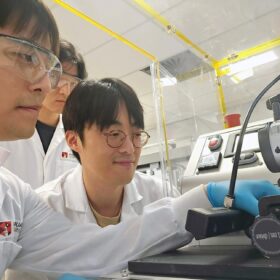
Researchers make green perovskite manufacturing breakthrough
Scientists at Macquarie University and the University of New South Wales have broken through significant barriers to perovskite solar cell industrial adoption with the discovery of ground breaking green manufacturing processes and materials.
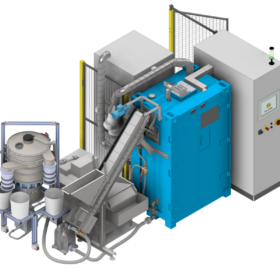
PV module recycling tech based on electrohydraulic shockwave fragmentation
An international research team has developed a new machine that utilises shockwaves to separate the different materials of a PV module. Chemical processes can be further used to extract silicon and silver. Results show the recovery of more than 99.5% of the original weight of the panels.
IEA blames slowdown in energy innovation on market uncertainty
The International Energy Agency warns that energy innovation is slowing as shifting priorities and financing changes hinder progress, despite past investments driving economic and security gains.