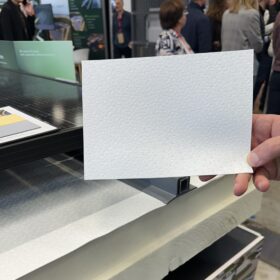
Renolit showcases reflecting cool roof membrane for bifacial rooftop PV
Renolit France has introduced the Alkor Bright reflective membrane for bifacial rooftop PV systems, offering high solar reflectivity and durability for flat or pitched roofs. The membrane helps keep buildings cooler while boosting the energy output of bifacial solar modules.

pv magazine Awards 2025 winners revealed
Excellence was on display across all eight categories in the pv magazine Awards 2025 with plenty of innovation in both established and new market segments. From world-firsts to second-life solutions, this year’s winners brought cutting edge solutions to challenges facing solar and storage. The time has come to reveal the winners and highly commended finalists…

Panasonic glass-based perovskite solar panels tested in office windows
Japanese electronics manufacturer Panasonic is testing its glass-based perovskite solar PV technology in office windows made by YKK AP, a construction and building materials company.
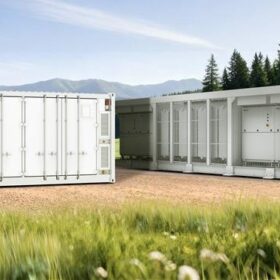
Trina Storage launches AC-coupled battery for utility-scale applications
Offered primarily as a 10 MW unit, the new product is also available in a 5.5 MW version for customers with specific requirements.
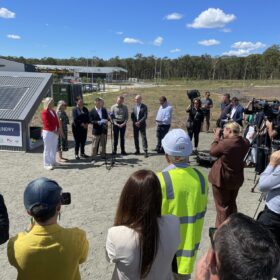
Sunman to build 500 MW solar panel manufacturing plant in NSW
Chinese manufacturer Sunman is to build a 500 MW per annum solar module production facility in the New South Wales Hunter Valley after securing funding support from both the state and federal governments.
JinkoSolar achieves 34.76% efficiency for perovskite-silicon tandem solar cell
JinkoSolar says it has increased the efficiency rating for its perovskite-silicon tandem solar cells from 34.22% to 34.76%, confirmed by China’s National PV Metric and Testing Centre.
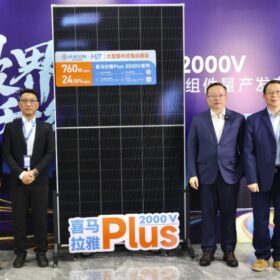
Huasun unveils 770 W, 2,000 V heterojunction solar module
The Chinese manufacturer said the higher-voltage design of the new module reduces cable, combiner, pile-foundation, and land-use requirements, delivering balance-of-system savings of up to CNY 0.15 ($0.032)/W in western China. The module offers a power output of 730 W to 770 W and a conversion efficiency of up to 24.8%.

Connected and islandable microgrid project launched in New South Wales
A collaborative project focussing on the development of connected and islandable microgrids within the Australian distribution network has been launched in New South Wales.
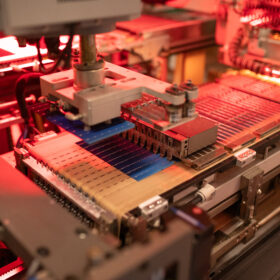
Tindo’s road ahead paved with funds, challenges and future-proofed growth
pv magazine spoke with Australian solar panel manufacturer Tindo Chief Executive Officer Richard Petterson about the company’s future expansion on the back of Solar Sunshot funding, and how it plans to tackle current market and manufacturing challenges to stay on course for future growth.
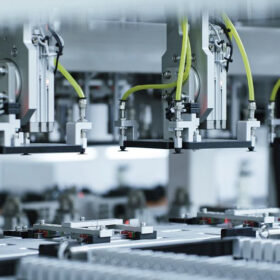
JinkoSolar achieves world record efficiency of 27.79% for TOPCon solar cell
The Chinese manufacturer says Germany’s Institute for Solar Energy Research Hamelin (ISFH) has independently verified the result.